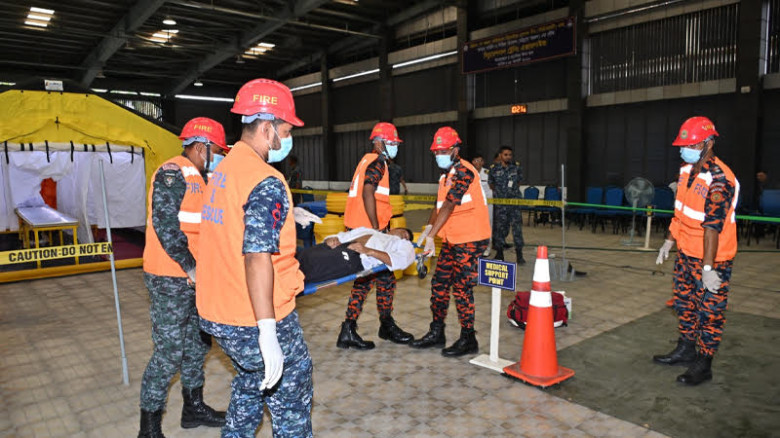

Bangladesh Navy and Fire Service and Civil Defense have conducted a joint exercise in Chittagong to enhance preparedness and integrated capabilities to deal with chemical accidents and subsequent emergencies.
The exercise, called ‘Situational Training Exercise (STX),’ was held under the management of the Navy at Banouja Isa Khan in Chittagong on Tuesday. 41 members of Agrabad Fire Service and Civil Defense and 455 members of the Navy participated in it.
The exercise practiced various emergency response strategies based on a real situation after a chemical accident. The issues of securing the accident site, controlling the risky area, preventing the spread of chemicals, rescuing the affected and endangered people, and transferring them to a safe place after providing first aid are important.
The exercise also practiced how to quickly control and extinguish fires in the event of a fire caused by chemicals. In addition, training was provided on assessing the damage of the accident, safety of rescue workers, and keeping emergency services operational.
The members participating in the exercise practiced dealing with emergency situations through mutual communication, sharing of responsibilities and coordinated decision-making. According to those concerned, such joint exercises will make inter-coordination between various organizations including the Navy, Fire Service and Civil Defense more effective.
The Bangladesh National Authority for the Chemical Weapons Convention (BNACWC) regularly organizes ‘Basic Assistance and Protection Course for Responders (BAPCOR)’ training to enhance the skills of members of various organizations. This joint exercise is organized in continuation of this.
There is a risk of chemical accidents and fires in Chittagong port, ships, industrial plants and various important facilities. In case of accidents at these places, coordinated preparation of the concerned organizations is very important for quick rescue, fire control and normalization of the situation.
The concerned believe that regular training and joint exercises will increase the ability to respond quickly in emergencies. At the same time, such exercises will play an effective role in reducing loss of life, damage to property and the environment, as well as ensuring the security of important economic and strategic facilities.