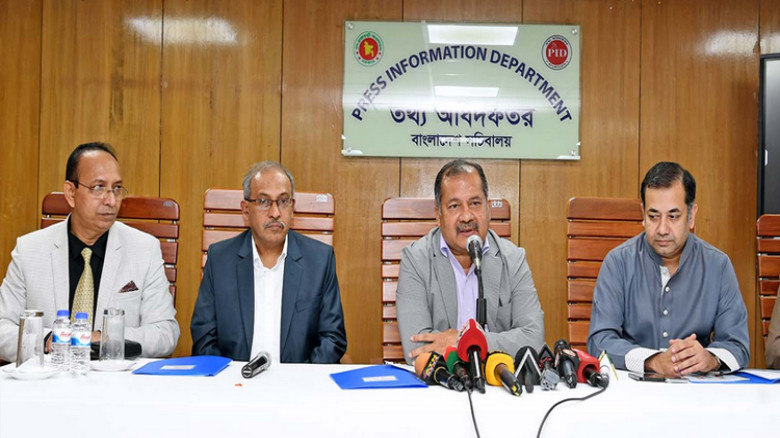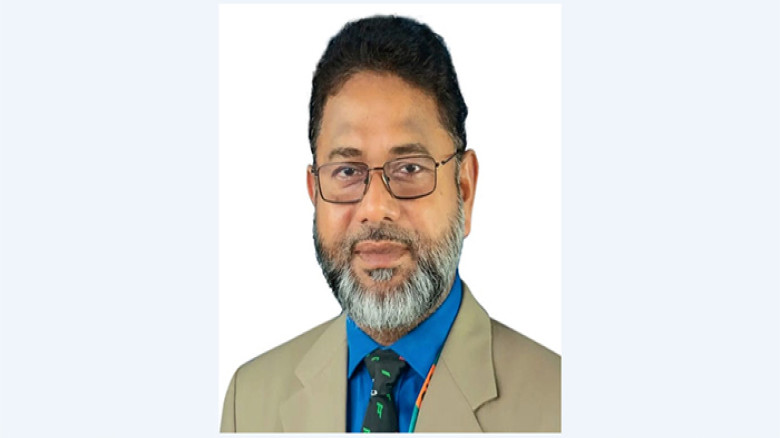
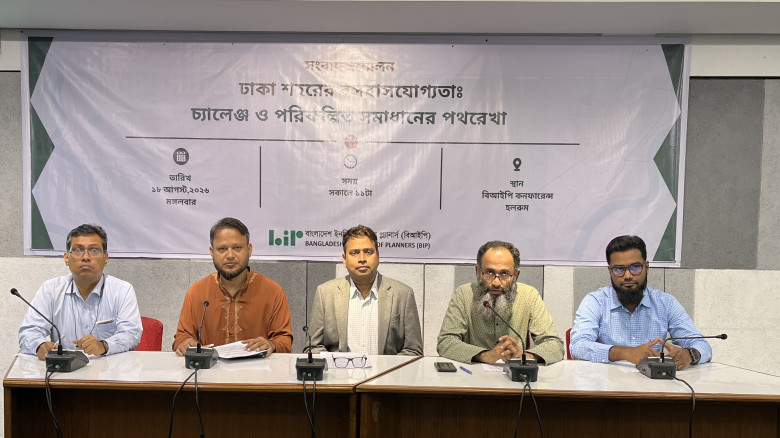

A press conference titled “Dhaka City Livability: Challenges and Roadmap for Planned Solutions” was held at the BIP Conference Hall located at the Planners Tower in the capital on 18 August 2026 (Tuesday) at 11:00 am. The press conference was attended by BIP President Planner Dr. Muhammad Ariful Islam, BIP Advisory Council Convener and Former President Planner Dr. Adil Muhammad Khan, Spatial Planning Expert Planner A. K. M. Riaz Uddin, General Secretary Planner Professor Dr. Mu. Mosleh Uddin Hasan and Board Member (National and International Liaison) Planner Talha Tasnim. The press conference highlighted various problems including Dhaka’s liveability crisis, unplanned urbanization, environmental pollution, waterlogging, traffic congestion, public health, waste management and lack of open spaces, and emphasized long-term and integrated planning, a press releases said.
Bangladesh Institute of Planners (BIP) General Secretary Planner Professor Dr. Md. Mosleh Uddin Hasan thanked everyone present in his opening speech at the press conference. He expressed concern about the current liveability situation in Dhaka and said that Dhaka is currently moving towards the lowest level of liveability. He mentioned that the current situation in the city has been created due to the plan being formulated but not being implemented properly and due to institutional weaknesses and lack of coordination.
BIP President Planner Dr. Muhammad Ariful Islam said that the main reason for discussing Dhaka’s liveability is that Dhaka is ranked 171st out of 173 cities in the Global Liveability Index, which is very worrying and its reflection is clear in Dhaka’s urban life. Transport, air and noise pollution, waterlogging, green and open spaces, public health, safety and social inclusion - these issues are directly related to urban planning. Dhaka is gradually becoming uninhabitable due to the lack of planned infrastructure and services to keep pace with rapid urbanization.
He mentioned that Dhaka is ranked 18th in the list of polluted cities in the world. While there were once about 56 canals in Dhaka, currently 26 canals do not exist. In addition, 48 areas of Dhaka city have been identified as waterlogging-prone areas. He mentioned unplanned urbanization, encroachment of canals and reservoirs and poor drainage system as one of the reasons for this. He also expressed concern about noise, visual and light pollution, saying that unplanned signboards, billboards and lighting are damaging the aesthetics of the city, environment and road safety. In addition, unplanned urbanization, excessive building density, waterlogging and poor waste management are increasing public health risks like dengue and chikungunya. Besides, he stressed the need to preserve green and open spaces, saying that out of the 99.29 square kilometers area, only 7.99% has green areas, which is insufficient for a livable city.
Regarding the transportation crisis, he said that about 5 million working hours are lost in Dhaka every year due to traffic congestion, which causes a financial loss of about 37 thousand crore taka. He also called for eliminating the deficit in waste management and utilizing the potential of creating new business sectors through recycling and energy generation from waste. He mentioned that about 1,765 tons (about 27 percent of total production) of waste is left outside collection and disposal every day, which is contributing to waterlogging on the roads and creating breeding grounds for mosquitoes. Stressing the importance of ensuring safe and accessible urban services for women, children, the elderly and differently abled people, he said that inclusive urban planning should be given priority in Dhaka’s future plan. At this time, he highlighted seven recommendations on behalf of BIP:
BIP recommendations:
Regardless of political or administrative changes, the continuity of the ongoing plan must be maintained and its full implementation must be ensured.
The basic structure of the approved plan cannot be changed or canceled for the commercial or personal interests of any individual, group or organization.
The progress and obstacles of the plan must be reviewed every five years based on the opinions of planners, experts, government agencies and local stakeholders, while keeping the main goals and objectives intact.
Instead of fragmented area-based, single-sector or short-term plans, integrated national and regional spatial plans must be formulated by integrating land use, transportation, environment, housing and economic activities.
No project can be taken up in wetlands, agricultural land, reservoirs or other environmentally sensitive areas without ensuring compatibility with the relevant approved plan.
Before approving any development project, a short ‘Planning Compliance Report’ must be submitted compulsorily after verifying its compatibility with the relevant plan.
Development activities should not be limited to isolated projects, but should be planned and long-term development, taking into account the urban and regional needs of the next few decades, environmental balance and the interests of future generations.
Finally, he said, not only Dhaka, but the development of the entire country should be brought under the long-term national spatial plan. Instead of thinking for a five-year period, continuous long-term planning and implementation should be ensured.
Planner Dr. Adil Muhammad Khan said, the livability of the city has increased in the last six months.