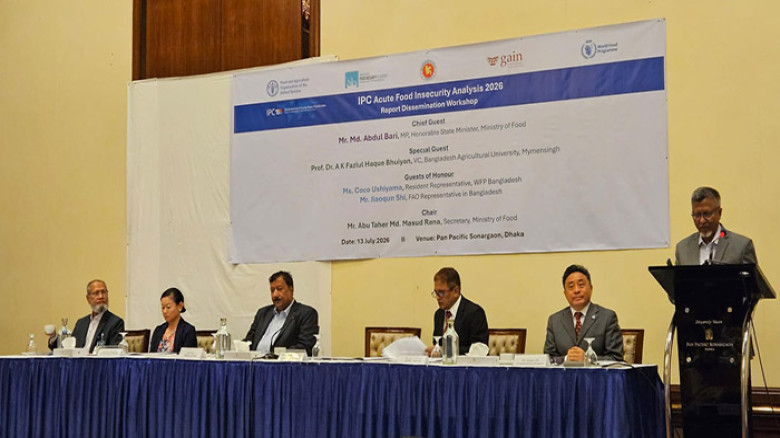

DHAKA: The Ministry of Food, together with the Food and
Agriculture Organization of the United Nations (FAO), the United Nations World
Food Programme (WFP), Action Against Hunger, Save the Children and the Global
Alliance for Improved Nutrition (GAIN), recently convened a high-level
dissemination workshop in Dhaka to launch and discuss the findings of the
latest Integrated Food Security Phase Classification (IPC) Acute Food
Insecurity Analysis for Bangladesh.
The analysis reveals that approximately 15.3 million people -
around 15 percent of the analysed population - are experiencing high levels of
acute food insecurity (IPC Phase 3 or above) between May and August 2026,
including about 483,000 people facing Emergency conditions (IPC Phase 4). The
situation is projected to deteriorate further between September and December
2026, when the number of people facing acute food insecurity is expected to
rise to 18.1 million, including 787,000 people in Emergency conditions.
The workshop was organized under the leadership of the Food
Planning and Monitoring Unit (FPMU) of the Ministry of Food and brought
together senior government officials, development and humanitarian partners,
academia and civil society representatives.
The analysis identified some of the highest levels of acute
food insecurity in the Chittagong Hill Tracts, the Haor region, selected
coastal districts, and among the displaced Rohingya population living in Cox's
Bazar and Bhasan Char.
"Bangladesh is committed to using evidence-based
analysis to guide policies and investments that protect food security and
strengthen resilience. The IPC findings will help us target resources more
effectively and reinforce our collective efforts to support vulnerable
communities facing increasing climate and economic pressures," said Mr.
Md. Abdul Bari, MP, Honourable State Minister, Ministry of Food.
“Evidence-based and data-driven decision-making is essential
for effective policymaking. I hope the findings of this IPC report will serve
as a valuable resource for policymakers, development partners, and humanitarian
agencies in designing targeted interventions, strengthening food and nutrition
security, and enhancing the resilience of vulnerable populations in
Bangladesh,” said Mr. Abu Taher Md. Masud Rana, Honourable Secretary, Ministry
of Food.
“Food security cannot be achieved by one institution alone.
It requires a whole-of-government and whole-of-society approach. The NGO
Affairs Bureau remains committed to supporting constructive partnerships with
NGOs, development partners, UN agencies, research institutions, and government
bodies to advance food security, nutrition, resilience, and sustainable
development in Bangladesh,” said Dr. Mohammed Jakaria, Honourable Secretary
(Director General), NGO Affairs Bureau, Prime Minister’s Office.
The report highlights a range of drivers behind the worsening
food security situation, including adverse climatic conditions, floods,
inflation, rising fuel and food prices, global supply chain disruptions and
broader economic challenges affecting household purchasing power. Without
timely interventions, these pressures are likely to further reduce access to
sufficient and nutritious food for millions of people.
Participants discussed key recommendations from the analysis,
including scaling up life-saving food assistance, expanding shock-responsive
social protection, strengthening climate-resilient agriculture, supporting
livelihood recovery, and investing in disaster preparedness and early warning
systems.
"The findings highlight the urgent need to strengthen
the resilience of agriculture and food systems, particularly in areas exposed
to recurrent floods, cyclones and other climate-related shocks. Emphasizing on
emergency agriculture strategy and investing in climate-smart agriculture,
sustainable livelihoods and local food production is critical not only to
address immediate food insecurity, but also to protect vulnerable communities
from future crises," said Dr Jiaoqun Shi, Representative, FAO.
"The IPC analysis is particularly valuable because it
helps us identify the communities most vulnerable to food insecurity before
shocks deepen their impact. Many of the areas highlighted in this analysis are
the same areas currently facing heavy rainfall and flooding, particularly in
the Chittagong Hill Tracts, where WFP has activated anticipatory action and
supported the Government's shock-responsive social protection response. Beyond
informing emergency response, the IPC strengthens the systems we rely on to
anticipate crises, target assistance more effectively, and build resilience
among vulnerable communities," said Ms. Coco Ushiyama, Representative and
Country Director, WFP
The Ministry of Food and its partners reaffirmed their
commitment to continued collaboration to address immediate food insecurity
needs, strengthen resilience to future shocks and support Bangladesh's efforts
to achieve sustainable food security for all.