
Policymakers, industry and TVET leaders emphasize changing social perceptions, industry-driven skills, employability and global workforce opportunities
Policymakers, government officials, industry leaders, educationists and technical education experts have called for a major shift in Bangladesh’s education and skills-development priorities, emphasizing that Technical and Vocational Education and Training (TVET) must become a mainstream pathway to employment, productivity and national development rather than being viewed as a secondary educational option, a press release said.
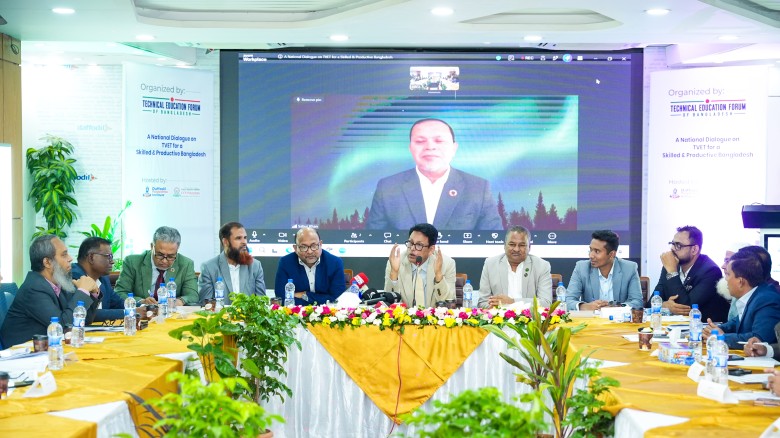
The call came at “A National Dialogue on TVET for a Skilled & Productive Bangladesh,” organized by the Bangladesh Polytechnic Institutes Forum and jointly hosted by Daffodil Polytechnic Institute and CCN Polytechnic Institute at Daffodil Plaza, Sobhanbag, Dhanmondi, Dhaka on August 23, 2026.
The high-level dialogue brought together policymakers, regulators, representatives of government agencies, polytechnic institutes, industry leaders, employers and skills-development experts to discuss how Bangladesh can transform its large working-age population into a skilled, employable and globally competitive workforce.
Dr. A. N. M. Ehsanul Hoque Milon, Hon’ble Minister for Education, Government of the People’s Republic of Bangladesh, attended the programme as the Chief Guest, while Mr. Saiyed Bin Abdullah, Special Assistant to Prime Minister on Youth Employment of Bangladesh was present as the guest of Honour. Dr. Md. Sabur Khan, Chairman of Daffodil Group and Founder and Chairman of the Board of Trustees of Daffodil International University, delivered the keynote speech.
Among the representatives of leading institutions and government agencies associated with technical education and skills development are Md. Daud Mia, NDC, Secretary of the Bangladesh Technical Education Board; Abul Khair Md. Akkas Ali, Director General of the Directorate of Technical Education (DTE); and Mir Zahid Hasan, Project Director of the ‘Accelerating and Strengthening Skills for Economic Transformation’ (ASSET) project. Engineer Mohammad Ruhul Amin, Chairman of the Bangladesh Technical Education Board (BTEB), along with representatives from the industrial sector and TVET institutions, participated in this dialogue. K M Hasan Ripon, Principal of Daffodil Polytechnic Institute, moderated the event while Dr. Mohammad Tariqul Islam Chowdhury, Chairman of CCN Family and CCN Polytechnic Institute, delivered the welcome address and Dr. Mohammad Nuruzzaman, Chief Executive Officer of Daffodil Family, delivered the vote of thanks.
Bangladesh Must Convert Its Demographic Advantage into a Skills Advantage
A central message emerging from the dialogue was that Bangladesh’s large young and working-age population represents a tremendous opportunity, but population alone cannot guarantee a demographic dividend.
Participants observed that the country needs a coordinated national strategy to transform its demographic advantage into a skills advantage by ensuring that young people acquire competencies relevant to industry, emerging technologies and changing domestic and international labour markets.
The speakers stressed that education should increasingly be connected with employability, productivity, entrepreneurship and economic participation, and that the success of the education and training system should ultimately be reflected in the ability of graduates to contribute effectively to the economy.
Social Perception of TVET Must Change The dialogue identified the prevailing social perception of technical and vocational education as one of the major barriers to expanding TVET in Bangladesh.
Participants noted that many students and parents continue to consider conventional university education as the preferred route to social recognition and career success, even when labour-market opportunities may favour technical and vocational skills.
The speakers therefore emphasized the importance of a sustained national awareness campaign to improve the dignity, attractiveness and social acceptance of technical professions.
Success stories of TVET graduates, technicians, skilled professionals and entrepreneurs should be widely highlighted, participants suggested, so that young people and their families can see technical education as a respected and rewarding career pathway.
Stronger Linkage Between TVET and Industry Another major recommendation of the dialogue was to substantially strengthen collaboration between TVET institutions and industry.
Participants emphasized that employers should play a stronger role in curriculum development, skills standards, assessment and practical training so that graduates possess competencies actually required in workplaces.
The dialogue highlighted the need for expanded apprenticeships, internships, workplace-based learning, industry certification, competency-based training and continuous curriculum modernization.
Speakers also stressed that rapid advances in artificial intelligence, automation, digital technologies, advanced manufacturing and other emerging fields require TVET institutions to continuously update both curricula and the competencies of teachers and trainers.
From Certificates to Competencies Participants called for a shift in emphasis from simply awarding certificates and diplomas towards ensuring demonstrable competencies and employability.
They observed that the real measure of a successful TVET system should be whether graduates can secure meaningful employment, perform effectively in workplaces, become entrepreneurs or successfully compete for skilled jobs internationally.
Quality assurance, internationally recognized certifications and stronger assessment of practical competencies were therefore identified as important areas requiring further attention.
Preparing Skilled Bangladeshis for Global Employment The dialogue placed particular emphasis on the enormous opportunities available to Bangladesh through the international labour market.
Participants observed that while Bangladesh sends a large number of workers abroad, many remain concentrated in comparatively low-skilled and lower-income occupations.
Bangladesh should therefore pursue a strategic transition from being primarily a labour-exporting country to becoming a skilled workforce-exporting country.
To achieve this, TVET programmes should increasingly consider the requirements of international employers and destination countries, including occupational competencies, foreign languages, communication skills, workplace culture and internationally recognized certifications.
Participants emphasized stronger coordination among the institutions responsible for education, technical education, skills development, labour and overseas employment to create effective pathways from training to international employment.
Entrepreneurship Must Be Part of TVET The National Dialogue also emphasized that TVET should not be designed only to produce job seekers.
Technical graduates should be encouraged and equipped to become entrepreneurs, freelancers, service providers and job creators.
Participants discussed the importance of incorporating entrepreneurship education, financial literacy, digital skills, business development support and access to financing into the broader TVET ecosystem.
Key Priorities and Recommendations Based on the deliberations, a number of priority areas emerged from the National Dialogue:
Position TVET as a mainstream national education and career pathway, rather than a secondary choice;
Launch sustained social-awareness initiatives to improve the dignity and acceptance of technical and vocational careers;
Align TVET curricula continuously with industry and labour-market demand;
Institutionalize stronger industry–institute partnerships;
Significantly expand apprenticeships, internships and workplace-based learning;
Focus on competencies, employability and productivity, not merely certificates;
Prepare students for emerging technologies and future occupations;
Strengthen the capacity and continuous professional development of TVET teachers and trainers;
Expand internationally recognized qualifications and professional certifications;
Develop skills programmes targeted at higher-value overseas employment;
Integrate language, communication and workplace-readiness skills into technical education;
Promote entrepreneurship and self-employment among TVET graduates;
Highlight successful TVET graduates and institutions to change public perceptions;
Strengthen coordination among ministries, government agencies, industry and training providers; and
Develop measurable national targets linking TVET enrolment, skills development, employment, productivity and economic outcomes.
TVET as a Driver of National Development The dialogue concluded that Bangladesh’s future competitiveness will increasingly depend on the quality and relevance of its human capital, and that TVET must play a central role in developing that human capital.
Participants emphasized that Bangladesh cannot fully utilize its demographic dividend unless education and training lead to relevant skills, and those skills lead to productive economic participation.
The emerging vision from the dialogue can be summarized as:
Demographic Dividend → Relevant TVET → Skills → Employment & Entrepreneurship → Productivity → Economic Growth → National Development
The participants also underscored the need to translate dialogue into action through stronger coordination between government, industry, educational institutions and skills-development organizations.
The Bangladesh Polytechnic Institutes Forum expressed its commitment to compile the observations and recommendations emerging from the National Dialogue and share them with relevant policymakers and stakeholders for consideration in future initiatives relating to TVET and skills development.
The National Dialogue concluded with a shared understanding that TVET should no longer be viewed merely as an alternative to higher education, but as a strategic national instrument for employment creation, productivity enhancement, skilled migration and sustainable economic development.