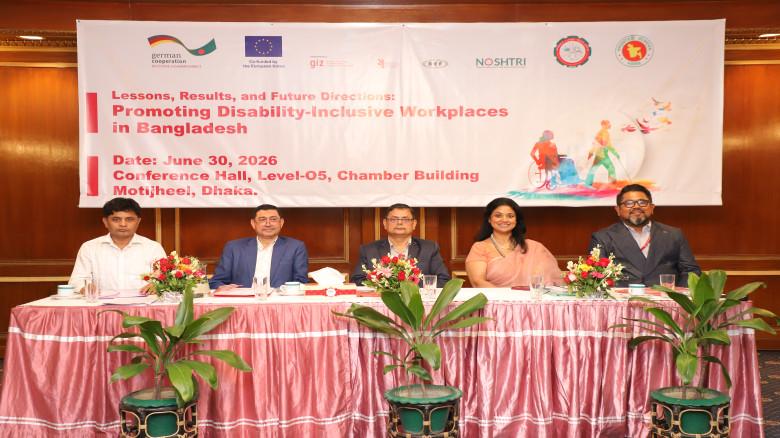

Bangladesh Business & Disability Network (BBDN), with support from Deutsche Gesellschaft für Internationale Zusammenarbeit (GIZ) GmbH, organized a programme titled “Lessons, Results, and Future Directions: Promoting Disability-Inclusive Workplaces in Bangladesh” at the Metropolitan Chamber Building, Dhaka. The programme brought together representatives from the Ministry of Labour and Employment, the Department of Inspection for Factories and Establishments (DIFE), the National Occupational Safety, Health Training and Research Institute (NOSHTRI), the Bangladesh Employers’ Federation (BEF), BGMEA, BKMEA, the International Labour Organization (ILO), medical professionals, industry representatives, development partners, and other stakeholders, a press release said.
The programme highlighted the achievements of the Social Protection for Workers in the Textile and Leather Sector (SOSI) project in advancing decent work, social protection, and disability-inclusive workplaces in Bangladesh. Key achievements included introducing Return-to-Work (RTW) systems in export oriented garment and leather factories, developing and updating RTW and Occupational Disease & Occupational Medicine (OD/OM) training modules, strengthening professional capacity, supporting Bangladesh’s Employment Injury Scheme (EIS), and officially handing over the RTW and OD/OM training modules to the National Occupational Safety, Health Training and Research Institute (NOSHTRI) to institutionalize national capacity.
The programme featured three technical sessions. Session 1: “Decoding the Policy Gaps” examined the alignment between the Bangladesh Labour Act 2006 and the Rights and Protection of Persons with Disabilities Act 2013, while discussing recommendations for strengthening implementation and the effective utilization of the Labour Welfare Fund. Session 2: “Return-to-Work in Action: From Policy to the Factory Floor” showcased the implementation of RTW programmes through a documentary, evaluation findings, and experience sharing from partner factories. Session 3: “Current Perspectives and Future Career Pathways on Occupational Diseases” highlighted emerging developments in occupational disease management and occupational medicine, while exploring future opportunities for developing skilled professionals in the field.
Speaking as the Chief Guest, Inspector General (Additional Secretary) of the Department of Inspection for Factories and Establishments (DIFE), Md. Forhad Siddique, emphasized the importance of strengthening occupational safety and health systems through collaboration among government, employers, workers, and development partners. He said:
“For a sustainable society, it is required that we ensure safety in workplaces and systems to return to work after injury and illness.”
The programme concluded with a shared commitment from government agencies, employers’ organizations, industry associations, development partners, and technical experts to build on the lessons of the SOSI project and further advance safe, inclusive, and resilient workplaces across Bangladesh.