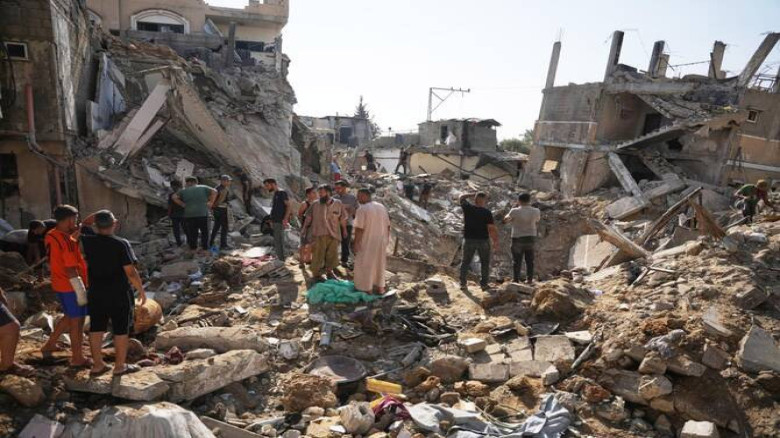


The haor region, where nature has poured out its boundless splendor, is today shrouded in the dark shadow of sadness. The soft, watery nature of poet Jibanananda Das's 'Ruposi Bangla' seems to be united with the tears of his children today. On the morning of May 2, when Ahad Mia saw his crops, which he had cultivated little by little, under water, his heart could no longer bear the burden. This death is not just of one person, it is an extreme reflection of the marginalized condition of the entire peasant society.
The spread of haors and baors - a watery map: The tomb and lamentation of the tears and crops of haors
Sylhet division is a huge submerged township in the northeastern part of Bangladesh. There are numerous small and large haors spread here in Moulvibazar, Sunamganj, Sylhet and Habiganj districts. Statistics show that there are about 155 haors and numerous baors in this division, the total area of which is huge. Especially the name of Tanguar Haor or Hakaluki Haor in Sunamganj is appreciated all over the world. The vast wetlands of this region are not only a storehouse of fish, but also a huge pasture for Boro rice.
Recently, the Sylhet division has been hit by a cruel blow of climate change. Without erasing the memories of the terrible floods of 2022 and 2024, the dreams of the farmers of Sunamganj and Sylhet have been shattered by this early flood of 2026. As soon as the ripe rice was harvested, the hilly flood came and took everything away. Today, there is only lamentation and 'cry of haor' all around.
Kishoreganj district under Dhaka division is called the 'capital of haor'. Bairds and wetlands are spread like a net in some parts of Kishoreganj, Netrokona and Munshiganj of this division. According to statistics, there are 52 haors in this division and countless baords. These water bodies take on the form of an ocean during the rainy season, and become golden rice fields again in the dry season.
When the scent of golden rice is supposed to fill the surroundings in Kishoreganj and Netrakona of Dhaka division, there is the smell of rotten rice. Thousands of hectares of land have been submerged in the sudden heavy rains, which have broken dams. Where rice is supposed to grow in the farmer's fields, waves of water are playing there today. This picture is all over the Dhaka division surrounded by haors.
In Mymensingh division, areas like Khaliajuri or Kalmakanda in Netrakona are completely dependent on haors. There are about 30 large haors in this division. The geography here is such that even with a little rain, the hilly flood from India engulfs the crop fields in an instant. Statistics say that agriculture in this region is mainly dependent on the ebb and flow of these haors.
The hilly flood from Meghalaya, India, is now an annual curse in Mymensingh division. Farmers in Netrokona say that when they see their hard-earned crops drowning before their eyes, they no longer have the will to live. This tragedy seems to rival even the Greek tragedy. Each wave is like a hammer blow on the farmer's chest.
Nasirnagar and Sarail upazilas of Brahmanbaria district in Chittagong division are an integral part of the haor region. The heart-wrenching cry of Rampur village in Nasirnagar proves that about 10 large haors in this division control the fate of farmers. These haors, located in the basins of the Meghna and Titas rivers, were once overflowing with fish and crops, which are now victims of climate change.
That pitiful scene in Nasirnagar, Brahmanbaria, highlights the real situation in Chittagong division. When the lifeless body of Ahad Mia, a 55-year-old farmer from Nasirnagar, Brahmanbaria, floated over the golden crops he had worked so hard to harvest all year, it was not just a death; it was an irreparable loss to the agricultural economy of Bengal.
Although there are many river-drained areas in Rangpur division, there are many small ‘bils’ or baor-like wetlands in Kurigram and Gaibandha. There are about 18 large beels and char areas here that behave like haors. Rabi crops and rice are cultivated in these vast sandbars and submerged areas, which play an important role in the local economy.
In Rangpur division, the scenes of farmers’ crops being destroyed by the encroachment of the Teesta and Brahmaputra are now a daily occurrence. Chinese almonds, maize and rice cultivated in char areas are rotting and being destroyed in sudden floods. What these people of the north grow with manual labor throughout the year is lost in an instant to the ravages of nature.
Although Rajshahi division is mainly known for the Barendra region, a large part of Chalanbil falls into this category. This Chalanbil, spread across Pabna, Natore and Sirajganj districts, is the largest inland wetland in Bangladesh. In addition to fish farming, a lot of rice is produced in the baors and beels here, with a total area of more than 800 square kilometers.
Waterlogging is now a big problem in the Chalanbil of Rajshahi division. Due to unplanned development and dams, water is not able to drain. As a result, the rice is drowning before it ripens. Thousands of farmers of Chalanbil are now destitute. Their tears seem to be mixing with the wind and flowing as a sigh.
The abundance of 'baors' or horseshoe-shaped lakes is most visible in Khulna and Barisal divisions. Especially in Jhenaidah, Jessore and Kushtia districts, there are 54 large baors. These wetlands in the southern region keep the local farmers smiling despite facing the challenge of salinity. However, the recent surge in tides and rising water levels are taking away this smile. Along with the intrusion of salt water in Khulna division, the impending cyclones and tidal waves are breaking the backbone of farmers. Once the crop is damaged due to salt water entering the cropland, nothing else can be grown there for a long time.
It is impossible not to mention Barisal and Patuakhali. The numerous small and large 'dons' or wetlands formed at the mouths of the rivers in this region bear the characteristics of haors. Farmers grow crops in about 40 large beels here.
In Barisal division, the farmers are in great distress due to the two-pronged attack of river erosion and tidal waves. Whenever the fields in this coastal town are filled with golden crops, some natural disaster comes and turns everything upside down. Today, our farmers in Bengal are tired of this long-term deprivation and unequal fight with nature.
Ten horizons to stop the crying: What we need to do
To stop the crying of haors forever, the government must first adopt a long-term 'master plan'. We must properly implement Delta Plan 2100 on the model of the Netherlands and build sustainable dams while maintaining the geological characteristics of the haors. Strict monitoring is needed to ensure that the natural flow of water is not obstructed in any way due to unplanned underwater roads or dams.
The Department of Agricultural Extension should come forward with short-term and short-life varieties of rice. If the rice ripening time can be brought forward by 10-15 days, it will be possible to protect the crop from early floods. In addition, arrangements should be made to increase the supply of harvester machines and harvest the crop quickly.
The Ministry of Communications and local governments should ensure that there are sufficient culverts and bridges while constructing roads in the haor area so that there are sufficient culverts and bridges for the movement of water. No development will be sustainable by blocking the water path.
The ICT Ministry can bring about a revolution in this regard. A sophisticated app and real-time data center should be developed to provide early warnings to every farmer in the haor area on their phones. If accurate weather forecasts can be delivered to marginal farmers through satellite images, they will be able to harvest their crops on time.
Strict legal action should be taken against those who embezzle money from the administration for the construction of dams. A 'Dam Protection Committee' should be formed with the involvement of local public representatives who will be engaged in guarding the dam day and night.
Farmers should be brought under the 'Crop Insurance' scheme on a cooperative basis. If a farmer loses his crop due to a natural disaster, the insurance company should immediately ensure compensation for his loss. This will give the farmer the strength to recover and no one like Ahad Mia will have to die in grief.
Dredging or river excavation activities should be intensified in the haor area. The bottom of the rivers has been filled with sediment for a long time, resulting in reduced water holding capacity. The Ministry of Water Resources should continue dredging activities throughout the year so that the monsoon water can drain quickly.
Local people should be made aware of the importance of protecting the biodiversity of the haor. Hijal-Karach gardens should be rebuilt to protect fish sanctuaries and absorb water naturally. The Forest Department should take up a special project in this regard which will protect the environment on one hand and protect the dam from the waves on the other.
Fertilizer and seeds should be easily available and interest-free agricultural loans should be provided during emergencies. Assistance should be provided directly to the bank accounts of the affected farmers for their rehabilitation. A digital database should be created in collaboration with the ICT Ministry so that the real victims get assistance.
Above all, we need to change our perspective. We should not consider haor as just an area of exploitation but as a living entity. It is the responsibility of all of us to ensure that poet Jasimuddin's 'Naksi Kanthar Math' does not become a crematorium. Only through the combination of technology and nature can the 'cry of haor' be stopped.
Finally, I would like to say that haor is our wealth, our existence. In the words of Rabindranath Tagore, 'The religion of man' is the protection of creation. Today, the state and society must stand in one row as that protector. The departed soul of Ahad Mia of Nasirnagar will find peace only when no more farmers have to watch their golden dreams sink under water. Let our pledge today be to protect the haor with our technology, policies and compassion.
By: Dr. Md. Anwar Hossain, Essayist, Writer and President of the International Anti-Drug Organization - Freedom International Anti-Alcohol. E-Mail Address: eddanwar@gmail.com