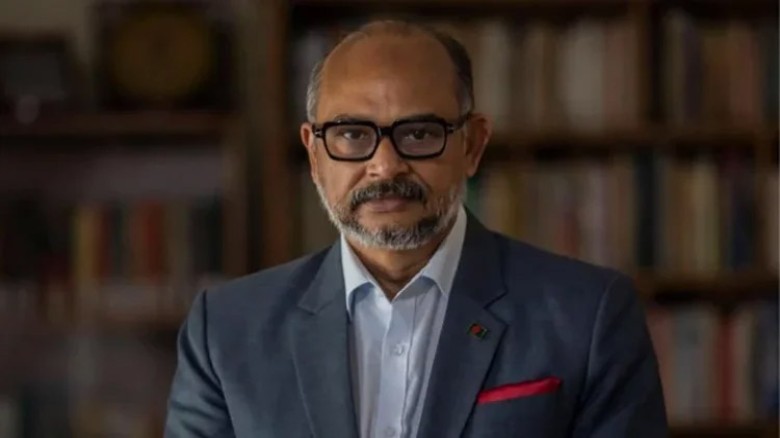


Bangladesh needs to move beyond a relationship centred predominantly on garments and trade and build a broader partnership with the United States based on investment, technology, innovation, skills, services and new industries, said Syed Ershad Ahmed, former president of the American Chamber of Commerce in Bangladesh (AmCham Bangladesh), while responding to a question about what the next 50 years of Bangladesh–U.S. business relations should look like.
Thirty Years of a
Growing Partnership
When AmCham Bangladesh began its journey three decades ago, bilateral trade between Bangladesh and the United States was below US$1 billion. Today, the relationship is dramatically larger. According to the Office of the United States Trade Representative, U.S. goods trade with Bangladesh was approximately US$11.9 billion in 2025, while total goods and services trade reached about US$13.7 billion.
That transformation tells an important story: The Bangladesh–U.S. commercial relationship has grown alongside Bangladesh's economy. AmCham Bangladesh has been an important part of that journey.
Ahmed is the founding Managing Director of Expeditors (Bangladesh) Ltd, the Bangladesh operation of Expeditors International of Washington, Inc., a U.S.-headquartered global logistics company and a Fortune 500 company. He has also served nine terms on the AmCham Bangladesh Board, including four distinguished terms as President.
“Over the past 30 years, AmCham member companies have invested and operated across an increasingly diverse range of sectors, including energy, banking and financial services, healthcare, food and beverages, logistics, hospitality, technology and the backward-linkage industries supporting Bangladesh's apparel sector,” Ahmed said.
These investments have brought much more than capital. They have introduced international standards, technology, management practices, professional expertise and global business networks.
American companies have trained employees, developed managers and exposed Bangladeshi professionals to international business practices and technologies. Many of those professionals have subsequently taken leadership roles across Bangladesh's private sector.
“In other words, investment has not simply created businesses,” Ahmed said. “It has helped build capabilities.”
AmCham's Contribution
Goes Beyond Business
The contribution of AmCham Bangladesh, Ahmed noted, has also gone beyond representing individual commercial interests.
Over the years, the chamber has advocated reforms that are important to Bangladesh's long-term competitiveness, including stronger energy security, food safety, better logistics and supply-chain infrastructure, protection of intellectual property rights, improved labour conditions, greater transparency and a more predictable investment climate.
It has also helped introduce and promote good business practices and international standards.
“These are not simply issues for foreign investors,” Ahmed said. “They are essential to Bangladesh's own economic future.”
The Relationship Has
Reached a New Stage
Ahmed, who is also a former president of the Foreign Investors Chamber of Commerce and Industry (FICCI), believes the opportunity today is considerably larger than it was 30 years ago.
“Bangladesh is no longer simply a low-cost manufacturing economy,” he said. “It has developed substantial capabilities in pharmaceuticals, financial services, information technology, telecommunications, consumer goods, logistics and export-oriented manufacturing.”
The country's large domestic market, young workforce and strategic location between South and Southeast Asia create additional opportunities.
At the same time, American companies are looking for new markets, resilient supply chains, technology partnerships and opportunities for long-term growth.
“The two countries therefore have a stronger basis for partnership than ever before,” Ahmed said.
Beyond Garments:
Where Can the Next Wave Come from?
Garments will remain critically important to Bangladesh. But Ahmed believes the country's future cannot depend on one sector alone.
Bangladesh Investment Development Authority's current investment strategy identifies a range of high-potential sectors, including pharmaceuticals, agro-processing, IT-enabled services, advanced textiles, renewable energy, logistics, electronics, medical devices and other technology-intensive industries.
Several areas deserve
particular attention.
Technology and
Artificial Intelligence
Bangladesh has a large and increasingly technology-oriented workforce. American companies can help accelerate the development of software, artificial intelligence, cybersecurity, cloud services, digital financial services and business-process operations.
“The ambition should be to make Bangladesh not simply a destination for outsourced work, but a regional technology and innovation hub,” Ahmed said, who also served as the President of The Foreign investors Chamber of Commerce and industry (Y 2011 - 2013).
AI could also transform traditional sectors. From smarter factories and supply chains to precision agriculture and healthcare diagnostics, Bangladesh can use technology to solve domestic problems while creating solutions for export.
Healthcare and
Pharmaceuticals
Bangladesh's pharmaceutical industry has developed significant manufacturing capabilities. The next opportunity is to move further into APIs, advanced medicines, biosimilars, medical devices, biotechnology and specialised healthcare.
American companies can bring technology, quality systems, research expertise and access to global markets.
“Healthcare can become more than a domestic expenditure,” Ahmed said. “With the right investment and standards, Bangladesh can develop healthcare products, services and expertise for regional markets.”
Agriculture and Food
Processing
Bangladesh's large agricultural sector offers enormous scope for modernisation.
American expertise in agricultural technology, cold chains, storage, packaging, food processing and food safety could help reduce losses, improve productivity and create higher-value food exports.
“The objective should be to move from exporting primarily agricultural commodities to producing branded, processed and globally competitive food products,” Ahmed said.
Energy, Logistics and
Infrastructure
Reliable energy and efficient infrastructure remain fundamental to Bangladesh's competitiveness.
The country needs investment in power, renewable energy, transmission, ports, railways, logistics and modern industrial infrastructure.
American companies possess expertise in energy technology, engineering, logistics and infrastructure development. Well-designed public-private partnerships could bring long-term capital and international expertise into projects that strengthen the wider economy.
“Better logistics, for example, would benefit garments, pharmaceuticals, agriculture, electronics and almost every other export sector,” Ahmed said.
Advanced
Manufacturing
Bangladesh's industrial base should gradually expand beyond traditional manufacturing.
Electronics, electrical equipment, medical devices, advanced textiles, light engineering, automotive components and other higher-value products can become important parts of the country's next export story.
Bangladesh can offer manufacturing scale and a large workforce, while American companies can contribute technology, design, management expertise and connections to global supply chains.
“That is the foundation of a genuine investment partnership,” Ahmed said.
Education, Skills and
R&D
Perhaps the most strategic investment, Ahmed believes, is investment in people.
The jobs of tomorrow will require skills in AI, robotics, data science, engineering, biotechnology, advanced manufacturing and cybersecurity.
American universities, technology companies and professional institutions could partner with Bangladeshi institutions to develop industry-linked education, joint training programmes and research centers.
Research collaboration could focus on Bangladesh's own challenges—flooding, climate resilience, traffic, water management, agricultural productivity and industrial waste—and turn those challenges into commercially viable solutions.
“This is where the relationship can move from technology transfer to technology creation,” Ahmed said.
From Investment to
Co-Creation
For Ahmed, this should be the defining idea for the next generation of the Bangladesh–U.S. relationship.
“For decades, the broad model was: Bangladesh produces, America buys,” he said. “The next model should be: Bangladesh and America invest, innovate and build together.”
That means more American companies establishing production and service facilities in Bangladesh.
It means Bangladeshi companies becoming suppliers to American global value chains.
It means joint ventures, research partnerships and technology collaboration.
And it means products and services developed jointly in Bangladesh being sold not only in Bangladesh, but to markets around the world.
What Bangladesh Must
Do
Investment does not follow opportunity alone. It follows confidence.
Bangladesh therefore needs to make its investment environment more predictable and competitive.
Foreign investors need faster approvals, reliable energy, efficient ports, transparent taxation, effective dispute resolution, stronger intellectual-property protection and consistent regulatory policies.
The U.S. Department of Commerce has continued to identify investment-climate and regulatory challenges that Bangladesh needs to address, even while recognising the country's strategic location and large workforce as important attractions.
“These reforms are not concessions to foreign investors,” Ahmed said. “They are requirements for Bangladesh's own economic future.”
LDC Graduation Should
Be a Catalyst, Not the Story
Bangladesh's LDC graduation process is an important milestone, although the government has sought additional time to prepare.
But Ahmed believes the larger question is what kind of economy Bangladesh wants to build over the next 10 to 20 years.
An economy based mainly on low-cost manufacturing will eventually face limits. An economy based on skills, technology, innovation, diversified exports, productive investment and strong institutions can continue creating new opportunities.
A Partnership for the
Next 50 Years
Bangladesh and the United States already have the foundation for a much deeper economic relationship. Now the relationship needs to evolve.
“Bangladesh needs capital, technology, management expertise, research capability and access to global value chains,” Ahmed said. “American companies need new markets, resilient supply chains, talented people and reliable partners.”
“The interests are
not identical—and they do not need to be.”
What matters is finding where those interests meet and building a stronger partnership around them.
The next chapter of Bangladesh–U.S. business relations should therefore not be defined only by how much Bangladesh exports or how much the two countries trade.
It should be defined by how much they invest together, innovate together, develop technology together, build skills together and create new opportunities for the global economy.
That is the partnership Bangladesh should aim for over the next 50 years.