
North South University (NSU) has inaugurated a two-day
international conference today under the theme "Encountering the
Humanities: Anxiety, Storytelling, Futurity". Organised by the Department
of English and Modern Languages (DEML), the prestigious academic gathering
brings together scholars, researchers, and students from 29 countries for
interdisciplinary dialogue on urgent questions reshaping human existence,
culture, and society in the twenty-first century, a press release said.
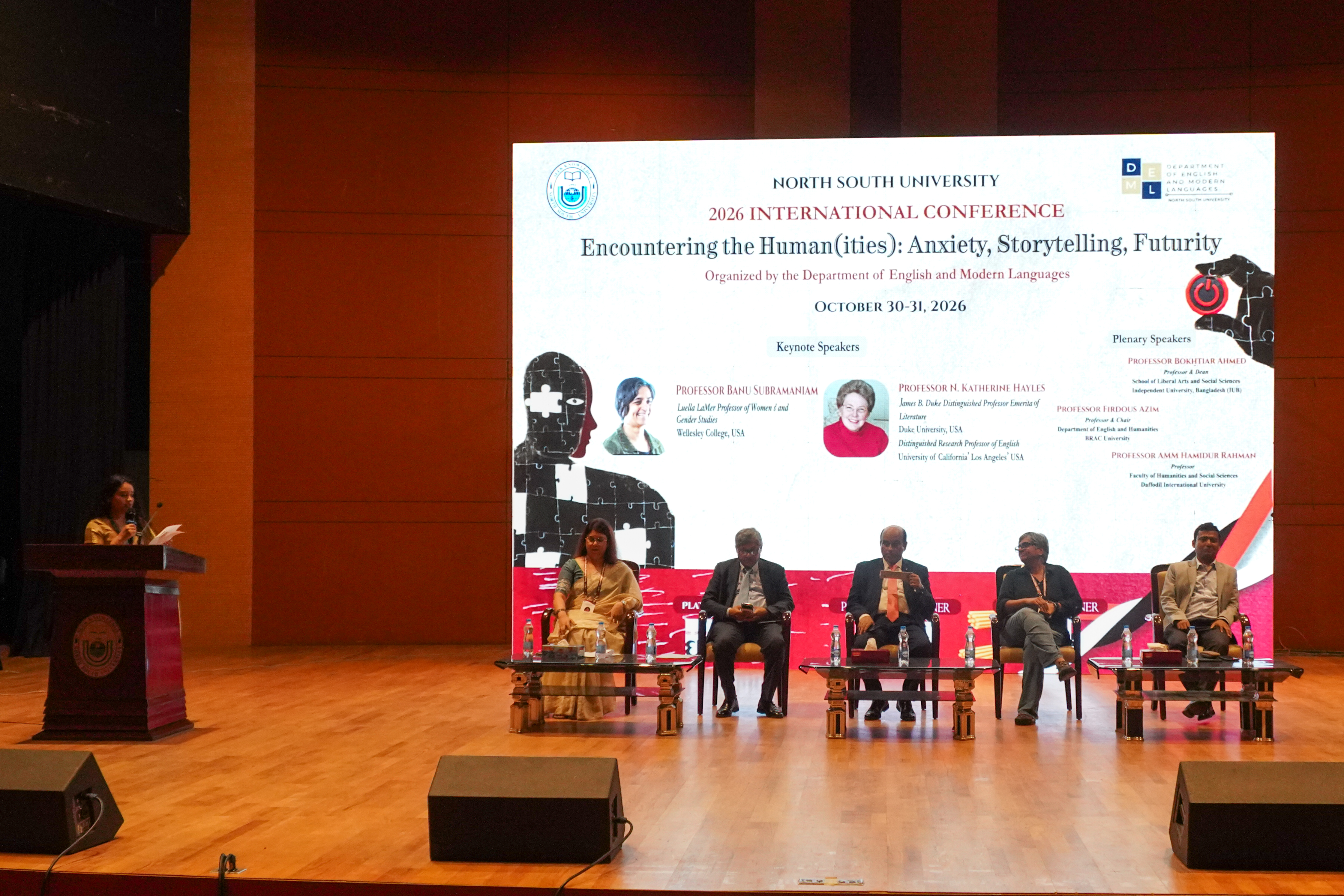
The grand inaugural session, held at the NSU Main
Auditorium, featured a keynote address by Professor Banu Subramaniam, Professor
and Chair of Women’s and Gender Studies at Wellesley College, USA. The event
was graced by Benajir Ahmed, Member and Former Chairman of the NSU Board of
Trustees, and Professor Abdul Hannan Chowdhury, Vice-Chancellor of North South
University, who presided over the session. Also present were Professor Muhammad
Rizwanul Islam, Dean of the School of Humanities and Social Sciences, and Dr.
Nazia Manzoor, Associate Professor and Chair of the Department of English and
Modern Languages.
Delivering her keynote address, titled “Migrant Ecologies:
Towards an Environmental Humanities of Place,” Professor Banu Subramaniam
examined the intersections of colonial history, botany, and migration through
the lenses of evolutionary biology and feminist theory. Drawing on these
perspectives, she called for a rethinking of conventional scientific
terminology and the adoption of more inclusive ways of understanding migration.
She said, “Migrant ecologies urge us to develop a new lexicon, moving away from
the colonial language of pioneer species and invasive species towards a
language of migration.”
Benajir Ahmed said, “In a rapidly changing world, we must
reflect on what it means to be human. For us at NSU, our responsibility is to
prepare graduates who combine professional competence with critical judgment,
magnificence, and compassion.”
Professor Abdul Hannan Chowdhury, Vice-Chancellor of NSU,
said, “The humanities and liberal arts must help us keep things aligned so that
we human beings remain in control and move towards building a civil society and
a livable planet.”
Professor Rizwanul Islam said, “The cognitive offloading
that we are often doing by being exposed to too much uncritical reliance on
technology is a grave threat to our human race as such.”
Dr. Nazia Manzoor said, “We focus on a timely inquiry into
what it means to be human at its core. The conference seeks to respond to
pressing, interwoven global transformations. Particularly the rise of
artificial intelligence, the ecological crisis, and shifting sociopolitical
realities.”
Following the inaugural session, the day's programme
featured a round table discussion titled “Encountering Our Present: English
Studies Now,” a poster display, academic sessions in different venues, and two
plenary presentations. Professor AMM Hamidur Rahman of Daffodil International
University spoke on “Storytelling to Alleviate Fear of Learning.” At the same
time, Professor Bokhtiar Ahmed of Independent University, Bangladesh, delivered
a plenary titled “Language as the Portal: Trailing History, Culture and Society
through Stories.”