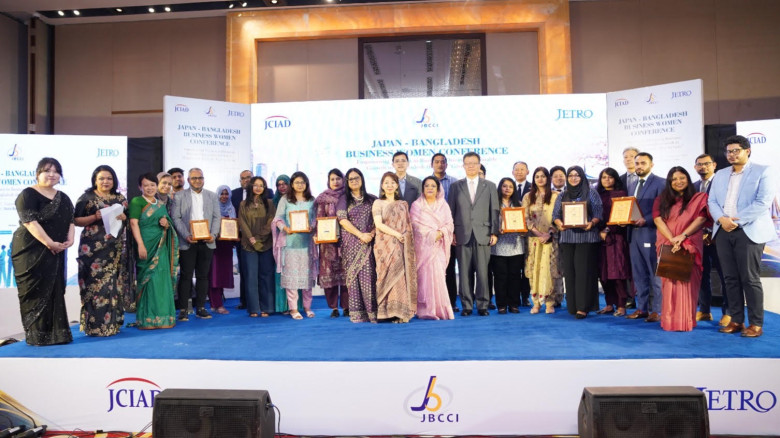

Civil Aviation and Tourism Minister Afroza Khanam on Sunday described Japan as a longstanding and trusted friend of Bangladesh, acknowledging its steadfast support during difficult times and significant contribution to the country’s development.
“Japan is an old and trusted friend of Bangladesh. Japan has stood by Bangladesh during difficult times,” she said while addressing the “Japan-Bangladesh Business Women Conference” as the chief guest at a city hotel this evening.
Afroza said Bangladesh and Japan are working together towards mutual prosperity, noting Tokyo’s significant contribution to the country’s infrastructure development and technological advancement.
The conference brought together representatives from Bangladesh and Japan to explore opportunities for expanding bilateral trade and investment, promoting women entrepreneurship and strengthening mutual cooperation.
Highlighting the importance of women’s empowerment in Bangladesh’s development, the minister recalled the role of former prime minister Begum Khaleda Zia in expanding educational opportunities for women.
She said Khaleda Zia had set a landmark example in advancing women’s education and empowerment by introducing free secondary education for girls.
“Following the example set by Begum Khaleda Zia, Prime Minister Tarique Rahman’s government has made education free for women up to the degree level,” Afroza said.
The minister said the government is working to build a prosperous, inclusive and developed Bangladesh by ensuring greater access to education and strengthening women’s economic empowerment.
The Japanese Ambassador to Bangladesh, the Chief Representative of the Japan External Trade Organization (JETRO), leaders of the Japan-Bangladesh Chamber of Commerce and Industry, businesspeople and women entrepreneurs, among others, attended the conference.
Participants discussed ways to further expand Bangladesh-Japan trade and investment, develop women entrepreneurship and deepen cooperation between the two countries.
Ambassador of Japan to Bangladesh Saida Shinichi in his speech said “As Bangladesh’s new government has announced its intention to attract more foreign direct investment, Japanese companies are increasingly showing interest in this growing market with its young population of nearly 200 million people. The Economic Partnership Agreement signed in February this year will further strengthen this positive trend.”
Ambassador of Japan to Bangladesh Saida Shinichi said this while speaking at the Japan–Bangladesh Business Women Conference under the theme “Empowering Women in Business: Driving Sustainable Growth in Bangladesh through ‘Give to Gain,’” organized by the Japan-Bangladesh Chamber of Commerce and Industry (JBCCI), with support of JETRO Dhaka and the Japanese Commerce and Industry Association in Dhaka (JCIAD) at Sheraton Dhaka on Sunday
He also said “I am confident that increased Japanese investment will also contribute to advancing women’s empowerment in Bangladesh by creating more opportunities for women’s participation in the economy.”
Saida Shinichi also “ The formation of the BNP-led government in February has brought fresh momentum and new opportunities. This momentum will contribute to creating an even stronger environment for expanding bilateral cooperation between Japan and Bangladesh across various fields, including women’s empowerment.”
Japan is still significantly behind Bangladesh in terms of women’s empowerment and can pursue the model of the latter as a source of inspiration, Ambassador of Japan to Bangladesh Saida Shinichi .
“ Japan is still significantly behind Bangladesh when it comes to women’s empowerment. According to international rankings, Japan is placed around 120th, close to the bottom, and we must continue working hard to improve our society in this area. Instead, I take Bangladesh as a source of inspiration, and we have much to learn from your achievements, “the Japan diplomat said.
“Today, I find myself as the only male among the distinguished guests, so I will keep my remarks brief. However, I would like to express my sincere gratitude to the organizers for inviting me today. My appreciation also goes to the supporting organizations, including United Jadro and CID, Osho Kokai, for their valuable contributions to this important initiative.”
Saida Shinichi said”Since the 2010s, Japan has introduced various measures to promote women’s participation, particularly in the workplace. These include maternity leave, parental childcare leave, equal pay for equal work, and initiatives focusing on improving work-life balance. In 2012, Japan also introduced legislation encouraging private-sector organizations to promote gender equality, with mechanisms to address non-compliance.”
He also said “As a result, an increasing number of women are taking leadership roles in our government, parliament, and businesses. However, these numbers remain far below those of Bangladesh, particularly in the political sphere. Nevertheless, I am proud to share that Japan had its first female Prime Minister last year.”
He also said “Women’s empowerment is a multifaceted issue that encompasses human rights, equality, demographic challenges, and the sustainability of society. I do not wish to go into all the details today. However, please believe me when I say that I am a strong advocate for women’s empowerment.”
He also said “Many of my points have already been addressed by the previous speakers, so I would like to express my full support for the presentations made today, particularly Dr. Meritor’s view that the essence of women’s empowerment lies in ensuring freedom of choice for every woman.”
Looking at Japan’s development cooperation, gender equality and women’s empowerment have long been among our central priorities. In Bangladesh, we have supported initiatives such as women-only coaches in metro systems and accessibility improvements in stations to make public transportation safer and more convenient for women, the Japan diplomat said.
He also said “Personally, I believe that one of the greatest achievements of Dr. Yunus’s microfinance model has been the empowerment of women living in poverty. Following this spirit, Japan, together with JICA, is implementing similar projects to promote financial inclusion, particularly in climate-vulnerable areas.”
Around 90 percent of the participants in these training programs have been women. Many of them have gone on to establish their own businesses, creating employment opportunities for other women as well. We are also supporting income-generating activities for women through local government initiatives and rural development projects.
Our cooperation extends further to areas such as nursing education, capacity building, and efforts to address gender-based violence.
Meanwhile, President of JBCCI Tareq Rafi Bhuiyan in his speech said “Bangladesh and Japan are natural partners in this journey. Bangladesh brings entrepreneurial energy and resilience; Japan brings quality, technology, discipline, Kaizen and long-term partnership. Together, we can help women-led businesses become investment-ready, export-ready and globally trusted.”
Takahashi Junko, Chief Representative, JICA Bangladesh; Kataoka Kazuiki, Country Representative of JETRO Dhaka and Joint Secretary General of JBCCI; Wagata Yuji, President of JCIAD, among others, also spoke on the occasion
He also said “For me, this relationship is institutional and deeply personal. My life has been shaped by Bangladesh and Japan—and by the strength and values of my Japanese mother. Within JBCCI, we already experience the value of women’s leadership. Our General Secretary Maria Howlader and Executive Director Tahera Ahsan hold important responsibilities, and their contribution, judgement and commitment have made a significant impact. They remind us that leadership is measured not merely by numbers, but by the difference one makes. Our aspiration must be to create space for many more capable women to rise.”
He also said “I also think about this as a father and business leader. In my succession planning, I hope that one day my daughter Siyana will lead our company, which I have founded with my father. But my responsibility is not simply to hand her a title. It is to prepare her through education, values, discipline and experience—and let her earn leadership from the ground up. I hope more families will see their daughters as future founders, successors, investors, board members and CEOs.”
He also said “Through a Japan-Bangladesh Women in Business Platform, JBCCI proposes to build a verified network of women entrepreneurs, executives and board-ready professionals; provide mentoring and business matchmaking; connect women-led enterprises with finance, technology, procurement and Japanese corporate networks; and strengthen their readiness for international markets. We should measure and report our progress—because commitment becomes credible when results are visible.”
Tareq Rafi Bhuiyan also said “Bangladesh has already shown the world what women can achieve. Women have transformed our garment industry, strengthened agriculture, advanced education and healthcare, led financial institutions, built enterprises and supported families and communities. Yet our next stage of development demands more.”
The JBCCI president said “We must move from participation to ownership; from employment to executive leadership; from micro-enterprise to scalable enterprise; and from local success to global markets. For many women, the challenge is not starting; it is moving from informal to formal, from micro to small and medium-sized, and from surviving to scaling.
Meanwhile, the conference brought together senior government representatives, diplomats, development partners, business leaders, entrepreneurs, academics, investors and professionals from Bangladesh and Japan to promote women’s economic empowerment, leadership, entrepreneurship and greater access to national and international markets.
The conference’s “Give to Gain” framework highlighted that when financial institutions provide fair access to growth capital, corporations open procurement opportunities, business leaders provide mentorship, and organizations ensure access to leadership positions, the country gains stronger businesses, improved governance, increased employment and more inclusive economic development.
Yuji Wagata, President of JCIAD, delivered remarks as a guest speaker. Keynote presentations were delivered by Maria Howlader FCA, Secretary General of JBCCI, and Shiori Onishi, Co-CEO of Euglena GG Ltd.
The programme also featured the successful entrepreneurial journey of Tawhida Shiropa, Founder of Moner Bondhu as well as remarks by Mr. Mitsuru Izumo, Founder and President of Euglena Co., Ltd. and Chairman of Euglena GG Ltd.
A high-level panel discussion, moderated by Maria Howlader FCA, examined the structural, financial, professional and social barriers affecting women’s participation in business and leadership.
The distinguished panelists were:. Akhter Sanjida Kasem FCA, FCMA, CFE, Managing Partner, A. Qasem & Co; Kazuiki Kataoka, Country Representative, JETRO Dhaka and Joint Secretary General, JBCCI; Yuri Miyagawa, General Manager, Machinery Department, Marubeni Corporation; Syed Mohammed Tanvir, Managing Director, Pacific Jeans Ltd.; andProfessor Dr. Melita Mehjabeen, Chairman, National Bank PLC and Professor, Institute of Business Administration, University of Dhaka.
The discussion focused on women’s access to finance, professional skills, technology, corporate procurement, formal business networks, safe workplaces, executive management and board-level opportunities. The speakers also emphasized the importance of assisting women-led businesses in becoming investment-ready, export-ready and capable of joining Japanese and global supply chains.
JBCCI also proposed developing a continuing Japan–Bangladesh Women in Business Platform to maintain a verified network of women entrepreneurs, executives and board-ready professionals. The platform would facilitate mentoring, business matchmaking, procurement connections, capacity building, technology adoption, export-readiness training and access to Japanese corporate networks.
The event included a special posthumous tribute to Late Ms. Kazuko Bhuiyan Sensei on the tenth anniversary of her passing, recognizing her lifelong contribution to friendship, cultural understanding and enduring people-to-people relations between Bangladesh and Japan.
Tokens of appreciation were presented to distinguished guests, speakers, panelists and supporting organizations. Hiroaki Oura, Vice President of JBCCI, delivered the closing remarks, reaffirming JBCCI’s commitment to promoting inclusive economic growth and stronger Bangladesh–Japan business cooperation.
The conference concluded with a call for measurable institutional commitments to increase women-owned businesses in corporate supply chains, expand access to finance, strengthen women’s participation in senior management and boards, and connect more women-led enterprises with Japanese and international markets.