
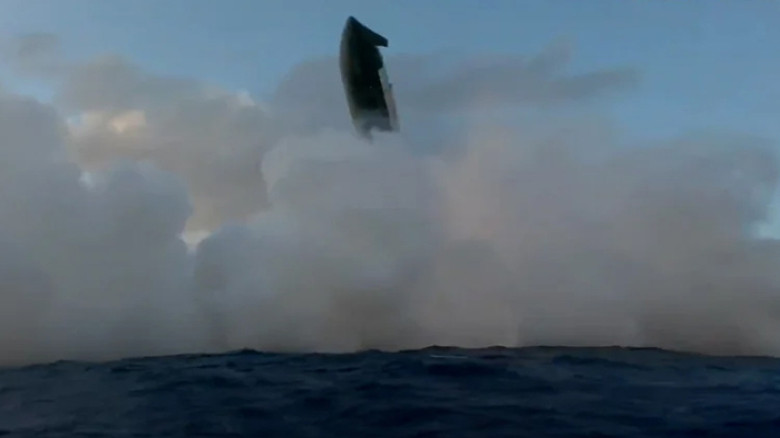

SOUTH PADRE ISLAND : SpaceX’s Starship spacecraft splashed
down into the Indian ocean Friday after the company performed a test flight of
the latest version of the enormous rocket.
The voyage was not without a few glitches, but SpaceX
employees shown on a livestream roared in delight following the trial flight
that comes as the firm prepares a potentially record initial public offering.
The mammoth rocket blasted off into space at just after
5:30 pm local time (2230 GMT).
The company did not intend to recover either the booster
or the upper stage, and the final splashdown was fiery but controlled, as
planned.
“Splashdown confirmed! Congratulations to the entire
SpaceX team on the twelfth flight test of Starship!” the company wrote on X.
The third-generation Starship spacecraft carried out a
maneuver that saw it flip upright and reignite its engines for control, despite
one being out of commission.
It also deployed its 22 mock satellites, including two
that attempted to photograph the spacecraft’s heat shield for analysis.
The vehicle had coasted through space but was not in
exactly the correct orbit after one of its engines malfunctioned during an
initial burn.
“I wouldn’t call it nominal orbital insertion,” company
spokesperson Dan Huot said, adding however that it was “within bounds” of a
previously analyzed trajectory.
After the Super Heavy booster separated from the upper
stage as expected, Huot said on the livestream that the booster failed to
complete its so-called boost-back burn.
The booster fell swiftly back to Earth, uncontrolled, into
the Gulf of Mexico. SpaceX wasn’t planning to recapture the booster anyway, but
was still hoping for a precision return.
The countdown clock stopped and started until it was
determined that the last-minute red flags could not be addressed in time.
Musk quickly posted on X that “the hydraulic pin holding
the tower arm in place did not retract.” SpaceX said that issue was corrected
overnight.
The company is facing extra scrutiny after SpaceX filed
earlier this week with US financial regulators to go public, likely in June, in
what is expected to become a record IPO.
Friday marks Starship’s 12th flight overall,
but the first in seven months.
The latest design is bigger than its predecessor, standing
at just over 407 feet (124 meters) when fully stacked.
There’s a lot riding on SpaceX’s progress: the company is
under contract with NASA to produce a modified version of Starship to serve as
a lunar landing system.
The US space agency’s Artemis program aims to return
humans to the Moon, as China forges ahead with a rival effort that’s targeting
2030 for its first crewed mission.
Ahead of launch, NASA Administrator Jared Isaacman
appeared during the pre-launch SpaceX program and said “we’re looking forward
to seeing this fly, because hopefully at some point in the not-too-distant
future we’re going to join up in Earth orbit.”
Both SpaceX and rival Blue Origin, the Jeff Bezos-owned
firm also vying to develop a lunar lander, have realigned their strategies to
prioritize projects related to Moon missions.
NASA is aiming to test an in-orbit rendezvous between its
spacecraft and one or two lunar landers in 2027 and carry out a crewed lunar
landing before the end of 2028.
But a lot needs to happen before then—and industry experts have voiced repeated skepticism that SpaceX and Blue Origin can achieve benchmarks in time.