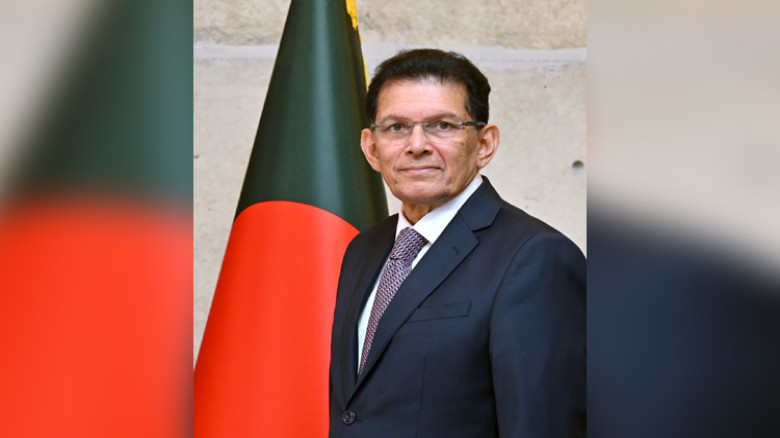

Bangladesh’s candidate and Foreign
Minister, Dr. Khalilur Rahman, has been elected President of the 81st Session
of the United Nations General Assembly (UNGA).
In the election held today at the United Nations
Headquarters, Dr. Khalilur Rahman secured 99 votes from the 193 Member States
of the United Nations, defeating the candidate of Cyprus, who received 91
votes. This landmark victory is a strong testament to the confidence and trust
that the international community places in Bangladesh, as well as to the
country’s growing diplomatic stature and constructive engagement within the
multilateral system.
This achievement is not only the election of a Bangladeshi
candidate to one of the most distinguished positions within the United Nations;
it also constitutes a significant international recognition of Bangladesh’s
longstanding commitment to multilateral diplomacy, international peace and
security, sustainable development, and global cooperation.
The successful outcome reflects the convergence of three key
factors: the visionary leadership and timely guidance of Prime Minister Tarique
Rahman, the coordinated and intensive diplomatic efforts undertaken by
Bangladesh within a limited timeframe, and the extensive experience,
professional excellence, and international standing of Dr. Khalilur Rahman.
At the time the BNP-led Government assumed office, less than
three months remained before the election. Despite the limited preparation
period, Prime Minister Tarique Rahman took a firm and decisive position in
support of Bangladesh’s candidacy. By nominating Foreign Minister Dr. Khalilur
Rahman, he expressed strong confidence that Bangladesh would emerge victorious
through focused diplomatic engagement and strategic outreach to Member States.
In this context, Prime Minister Tarique Rahman recalled
Bangladesh’s successful election to a non-permanent seat on the United Nations
Security Council in 1978. At that time, under the courageous and visionary
leadership of the late President Ziaur Rahman, Bangladesh mounted an effective
diplomatic campaign within a short period and prevailed over the then
formidable candidate, Japan, to secure its election to the Security Council.
Drawing inspiration from that historic achievement, he had expressed firm confidence
from the outset that Bangladesh would similarly succeed in the election for the
Presidency of the 81st Session of the General Assembly.
One of the biggest
challenges for Bangladesh has been the severe limitation of time. Although
Bangladesh formally announced its candidature in 2020, the Government nominated
Foreign Minister Dr. Khalilur Rahman as its candidate on 27 February 2026,
following which the country launched its full-scale international campaign.
Through high-level bilateral meetings, sustained diplomatic
outreach, and multilateral engagement with all 193 UN member states, Bangladesh
has actively sought to build broad international support within very short
time. Bangladesh, in practical terms, has successful conducted five years’ worth of diplomatic campaigning
in just three months.
In contrast, Cyprus announced its candidature as early as
2016 and has maintained a continuous campaign for nearly a decade, particularly
intensifying its outreach efforts over the past year.
Bangladesh’s campaign has been spearheaded by Foreign
Minister Dr. Khalilur Rahman, State Minister for Foreign Affairs Shama Obaed
Islam, and the Prime Minister’s Adviser on Foreign Affairs Humaiun Kobir,
supported by Bangladesh’s missions and embassies worldwide.
The distinguished professional experience, diplomatic
acumen, and proven leadership credentials of Bangladesh’s candidate contributed
significantly to this landmark achievement. A major milestone in the campaign
came on 13 May 2026, when Bangladesh’s candidate Dr. Khalilur Rahman
participated in the Interactive Dialogue organized by the current President of
the General Assembly, Annalena Baerbock. During the two-and-a-half-hour
session, Dr. Rahman presented his vision statement and outlined his priorities
and work plan for leading the General Assembly. The dialogue was widely praised
within diplomatic circles.
Following these extensive engagements and consultations,
nearly 30 Member States formally conveyed their support for Bangladesh’s
candidacy, reinforcing growing confidence in the country’s vision and
leadership. This broad-based endorsement placed Bangladesh on a clear and
credible path towards electoral success.
Bangladesh's campaign has placed particular emphasis on
strengthening effective multilateralism, safeguarding the interests of
developing countries, enhancing international cooperation for
climate-vulnerable states, advancing the implementation of the Sustainable
Development Goals, supporting UN peacekeeping efforts, and amplifying the voice
of the Global South. The campaign has been widely viewed as issue-based,
inclusive, and grounded in principles
The Government of the People’s Republic of Bangladesh
expresses its profound appreciation to the Member States of the United Nations
for the trust and confidence reposed in Bangladesh through this historic
election. The Government further reaffirms its unwavering commitment to the
purposes and principles of the United Nations Charter and to working
constructively with all Member States in advancing multilateralism,
international peace and security, sustainable development, and effective global
cooperation.