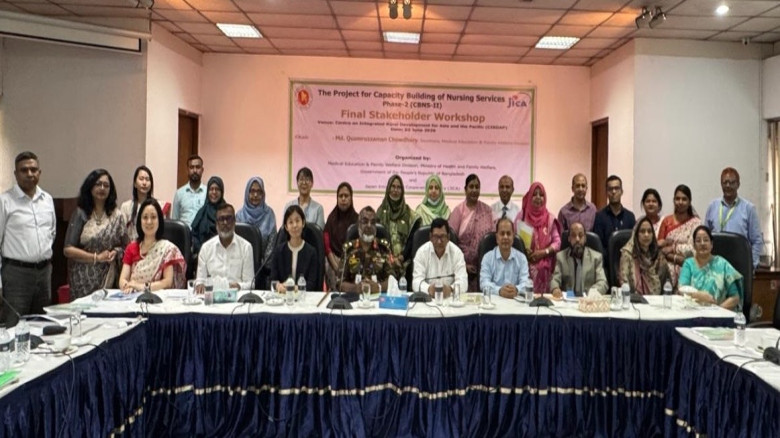

The Final Stakeholder Workshop of the Project for Capacity Building of Nursing Services Phase II (CBNS-II), supported by the Japan International Cooperation Agency (JICA), was held on June 2, 2026, at The ATM Shamsul Haque Auditorium, CIRDAP, Dhaka. The event marked the conclusion of a four-year initiative implemented from March 2022 to June 2026 to strengthen nursing education and clinical practice across Bangladesh, a press release said.
The workshop brought together representatives from the Ministry of Health and Family Welfare (MOHFW), Directorate General of Nursing and Midwifery (DGNM), Bangladesh Nursing and Midwifery Council (BNMC), Bangladesh Nursing Association (BNA), public nursing colleges, medical college hospitals, and development partners. Implemented in close collaboration with these institutions, CBNS-II implemented a range of practical activities to strengthen nursing education and clinical practice in Bangladesh. These included strengthening practical guidance manuals, developing 64 Master Trainers and 472 Clinical Nurse Teachers, and providing faculty development and nursing management training. The project also supported accreditation for four nursing colleges and promoted institutional networking across eight public nursing colleges and their affiliated hospitals.
A central focus of the workshop was the sharing of key achievements of CBNS-Ⅱ, together with discussions on how to sustain and further expand effective approaches beyond the project period.
In this context, the CBNS model - a practical framework developed from project experiences to support continuous improvement in nursing education and clinical practice – was presented as a key framework for future implementation. The model promotes cascade training, active learning, college-hospital collaboration, and mutual learning among institutions as replicable approaches for ongoing system strengthening.
Speaking on the occasion, Morikawa Yuko, Senior Representative of JICA, said, “The purpose of today’s workshop is not only to highlight the achievements of the project, but also to facilitate meaningful discussions on how the initiative can be further strengthened, scaled up, and sustained in the future, as well as the role that various stakeholders can play in advancing these efforts. With the successful completion of CBNS-II, I am confident that the foundations established through the project will contribute to its continued success and long-term impact.”
Participants engaged in substantive discussions on pathways to sustain and expand the effective approaches introduced through the project, including the continued utilization of trained human resources and strengthening of institutional mechanisms. Discussions underscored the importance of continued collaboration among government agencies, educational institutions, healthcare facilities, professional bodies, and development partners in supporting future implementation by the Government of Bangladesh.
Md. Nora Alam Siddiqui, Additional Secretary, Medical Education Division under the Ministry of Health and Family Welfare, said, “I am delighted to witness the significant progress made in nursing education and clinical nursing practice. I firmly believe that if the achievements and best practices of the CBNS-II project are adopted and implemented across nursing colleges, hospitals, and healthcare facilities throughout the country, they will contribute substantially to improving the quality of healthcare services and generating broader benefits for the nation.”
The workshop concluded with a shared commitment to advancing sustainable, institution-based approaches, including further strengthening and institutionalization of the CBNS Model and related capacity development mechanisms, to support improved nursing education and clinical practice standards throughout Bangladesh.