
The Bangladesh University Grants Commission (UGC) has taken the initiative to launch a third language education program in 30 public and private universities of the country with the aim of enhancing the multilingual skills of students in addition to Bengali and English, making them competitive in the international job market, and contributing to national manpower development. The commission is working with the aim of starting this program by January 2027, a press release said.
The committee formed for university selection, language determination, necessary resources and location mapping has been reconstituted so that no area of the eight divisions of the country is outside the scope of this program. This program will be implemented by considering the manpower needs of the concerned region, the interest of the local people, the capacity of the university and the existing infrastructure.
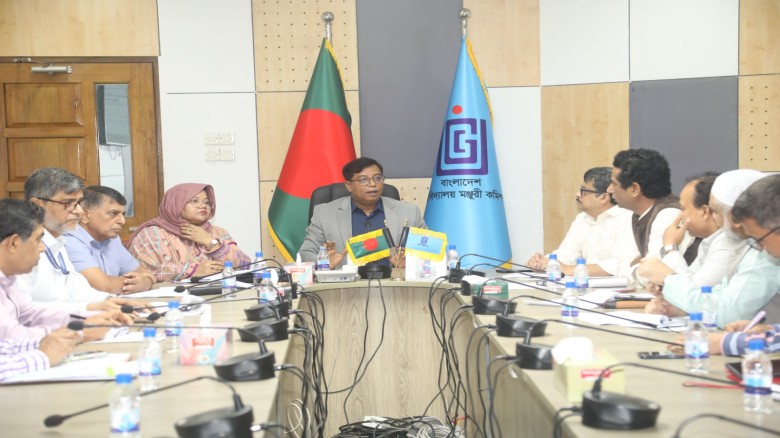
UGC Chairman Professor Dr. Mamun Ahmed said these things in his presiding speech at a meeting organized at UGC on the third language education program on Wednesday (August 19, 2026). UGC members Professor Dr. Machuma Habib, Professor Dr. Abdullah Al-Mamun, Professor Md. Mehedi Hasan Khan, Professor Dr. Md. Aslam Hossain, Professor Dr. Niaz Ahmed, UGC Secretary Dr. Md. Fakhrul Islam and the heads of departments of the commission were present.
The UGC Chairman said that considering the government’s priorities and the future job market needs, an initiative has been taken to teach students a total of eight languages as a third language along with Bangla and English. Through this, the linguistic and professional skills of the students will be enhanced, international communication capabilities will be developed and new employment opportunities will be created in the country and abroad. At the same time, this initiative will play an important role in national skill development and the formation of skilled and qualified manpower.
He said that in the initial stage, initiatives will be taken to establish new language education centers in 30 government and private universities of the country or to modernize the capacity and infrastructure of the existing language education centers. In selecting universities, the manpower needs of the concerned area, the interest of the local people and the potential of the regional and international labor market will be taken into special consideration.
Professor Dr. Mamun Ahmed said that by analyzing the information of Bangladesh Manpower Employment and Training Bureau (BMET) and other relevant data, the demand for which language will be higher in which region will be identified. Based on this, a realistic mapping of demand-based language selection and university-based activities will be prepared.
The third language education program plans to include eight languages - Arabic, Chinese, Japanese, Korean, French, German, Spanish and Italian. Among these, the issue of initially giving priority to Arabic, Japanese, Korean, Chinese and Italian was discussed in the meeting. However, which language course will be launched in which university will be finalized by considering the needs of the respective region, the capacity of the university, the required manpower and infrastructural facilities.
It was informed in the meeting that currently there are language education centers in 10 universities of the country. Out of these, Dhaka University has the opportunity to learn a maximum of 13 languages. The capacity of the existing language education centers, courses conducted, instructor and manpower structure and infrastructural facilities will be reviewed, and the need for establishing new language education centers will also be determined.
Special emphasis is placed on creating skilled and trained trainers for the successful implementation of the third language education program. In addition to building a skilled training team through training of teachers and related persons of the universities, there is a plan to take cooperation from experienced language experts and institutions of the concerned countries as needed.
The UGC Chairman said that the UGC will play a necessary role in supervising the activities of the language education centers and ensuring quality. Assistance will be provided in formulating the necessary manpower structure for the centers, establishing modern language labs and using technology-based educational materials. At the same time, special monitoring will be done to ensure that these centers do not become commercial institutions and that students get the opportunity to receive quality language education at affordable costs.
He further said that in addition to regular students of the university, other interested persons will also get the opportunity to learn languages at affordable prices under the prescribed policies. As a result, university-centered knowledge and skill development programs will be further expanded and the larger population of the country will get the opportunity to acquire multilingual skills.
Initiatives will be taken through the UGC to formulate a uniform policy and management structure for the smooth, integrated and sustainable implementation of this program. The policy will include essential issues including language selection, course management, instructor recruitment and development, quality assurance of education, infrastructure, use of technology, and supervision of centers.