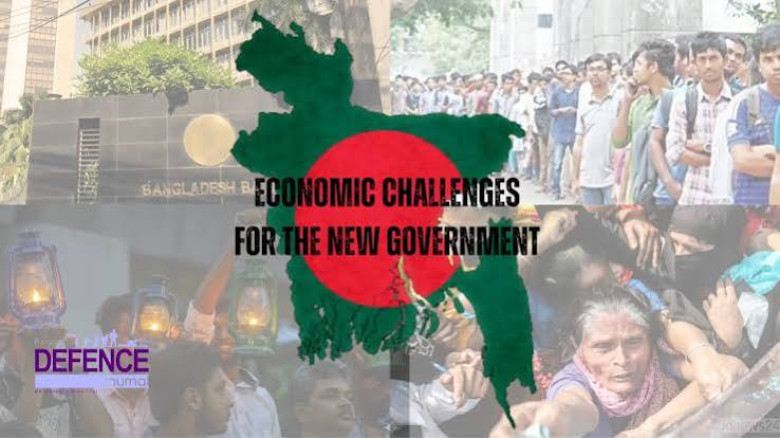

The present BNP government of Mr Tarique Rahman government is near completion of six months. This is a short period to evaluate a new political government. The BNP government has some major challenges like generating new employment, curbing corruption, streamlining the banking sector, ensuring good governance, sound law and order situation and energy security, curbing price of commodities, attracting new investment and protecting minorities, said economists, business leaders and policy makers.
High economic disparity, corruption, nepotism, slow employment creation, Russia-Ukraine war, siphoning off state wealth out of the country by some corrupt persons have created a crisis in the economy, said a retired professor of the economics department of the Dhaka University while talking to this correspondent.
The interim government of Nobel laureate Professor Dr Mohamamad Yunus got over 18 months to repair the country and held a peaceful, credible and transparent parliament election on February 11, 2026 . Bangladesh Nationalist Party got two-thirds majority in the election and Mr Tarique Rahman became the Prime Minister of the country.
The present BNP government has also got a shattered economy and the people of this country need patience to overcome economic mess that Sheikh Hasina left while fleeing to neighboring India
The energy crisis has deepened in Bangladesh as the country is experiencing load-shedding during the scorching hot weather and local and export-oriented industries are curtailing the production leading to incurring losses, said a leading industrialist while talking to this correspondent
Dr Ijaz Hossain, Professor of Department of Chemical Engineering of Bangladesh University of Engineering and Technology (BUET), while talking to The Bangladesh Mail said that Bangladesh usually experiences load-shedding during summer season
Dr Ijaz Hossain said the interim government has been in a catch 22 situation and the BNP government was not prepared to experience this situation
To a question how Bangladesh can attract US investment in the Indian ocean on a win-win basis, Dr Ijaz Hossain, Professor of Department of Chemical Engineering of Bangladesh University of Engineering and Technology (BUET), said “Bangladesh did manage to attract investment from USA companies in its oil and gas sector. Several oil and gas companies got involved in exploration during the mid-nineties. In fact, one of the largest fields, which is providing nearly 50% of our present gas supply, was discovered by an American company, Occidental, in 1998. UNOCAL later joined Occidental; but Chevron acquired UNOCAL. At that time many other USA companies showed interest in exploring for oil and gas in Bangladesh, but Bangladesh failed to attract these companies. At that time the left-wing parties mounted a severe campaign against US interest in Bangladesh. This has created a very negative impact among the USA companies.
The USA is the leading country in terms of technology to extract oil and gas. The center of excellence and of advanced technologies relating to oil and gas are North America and a portion of the EU (Norway and UK). Not only do these two regions have the best technology, they also have spare cash to invest.
Meanwhile, a UN tribunal in 2014 awarded Bangladesh nearly four-fifths of an area sprawling over 25,000 sq km (9,700 sq miles) in the Bay of Bengal, ending a dispute over a sea border with India that has ruffled ties between the neighbours for more than three decades.
Due to heavy reliance on imported fuel to run Bangladesh's energy sector, the country now requires $5.7 billion annually to cover the cost of power from India, as well as Liquefied Natural Gas (LNG), coal, and petroleum products for power generation.
A Southeast Asian diplomat while talking to this correspondent said “The present government should be transparent in telling the countrymen they have to suffer in the short term as the government in the past did not plan energy security in the long-term. Fuel subsidy is unsustainable; the subsidy needs to be gradually reduced. The government must cut back spending in other areas. The government should step up measures to try to save fuel or reduce energy use and enforce rules on saving energy.”
“On medium and long term, the government should find long term alternatives to current fuel sources and quickly issue off-shore contracts and cancel contracts that have not been implemented. The country cannot take short cuts or the easy way. there are no easy ways” he said.
The improvement in law and order situation and curbing the threat of international terrorist groups are a major task of the BNP government as UN Security Council monitoring report has expressed concerns in its report, said a professor of Dhaka University.
Foreign diplomats, development partners and international investors are closely watching the law-and-order situation as the police service is going through transition period
Though Bangladesh does not have proper statistics over the money laundered during Awami League period, rough estimates prepared by some think-tank like Centre for Policy Dialogue said that some businessmen in connivance with politicians siphoned off over 200 billion US dollars out of the country during the last 15 years.
“The recovery of laundered money is a herculean task as well as time consuming. The global success rate is 5-10 per cent and the short period of recovery is a minimum 5-6 years. The recovery of laundered money during the rest 4 years and a half years of the BNP government will remain a major challenge” said a former managing director of a commercial bank while talking to the daily capital Views
Meanwhile, business leaders, educationists and policy-makers have laid stress on market-oriented educational curriculums to groom the youths who are entering the job market. Lamenting high-level unemployment among the educated youth in Bangladesh, they said a job-market-oriented education system can improve the situation.
Over 20 lakh youths are entering the job market in Bangladesh every year. However, this manpower can't match the requirements of the local economy as local Bangladeshis can't cater to the demands of the industries.
Against this backdrop, Bangladesh will have to set up high quality higher educational institutions. The economy of the country needs skilled human resources to cope with increasing economic growth.
President of the Bangladesh Chamber of Industries Anwarul Islam Parvez said the government would outline short-, medium- and long-term strategy to create new jobs as some 20 lakh youths enter the job market every year.
He expressed the views that a special human resource division can design educational curricula to fit into the job market. As only a few thousand jobs are created in the government sector, the private sector needs to create new job opportunities to absorb the youth, said Anwarul Islam Parvez, also a leading readymade garment exporter of the country.
The USA -Israel imposed war on Iran that began on February 28, 2026 with some pauses and created an energy crisis globally and the manpower export suffered during the same period, said a Baira leader. The manpower export will suffer unless peace and stability are ensured in the middle east, he said.
State Minister for Expatriates' Welfare and Overseas Employment Nurul Haque Nur told parliament that the government has set a target of sending around 1.4 million Bangladeshi workers abroad in the 2026-27 fiscal year.
Nur said a total of 9,33,815 Bangladeshi workers secured jobs in different countries between 1 July 2025 and 31 May 2026. …… BMET data show that 65,634 workers received overseas employment clearance in February 2026, followed by 44,658 in March, 48,859 in April and 60,119 in May, 71,742 in July and 26,545 workers during August 1-15, 2026
He also said diplomatic negotiations are ongoing with Malaysia, Oman, the United Arab Emirates, and Bahrain to reopen or expand labour markets
The BNP government should ensure a sound law and order situation and protect business establishments and businessmen to revive the economy, said a top business leader.
The economy of Bangladesh has suffered a massive blow during the student movement on quota system in the government job during the period of July, 2024, said a top leader of the Japan-Chamber of Commerce and Industry (JBCCI).
He said the economy will require at least 5 years to overcome the loss centering movement and violence and laid emphasis on normalcy to run business.
Meanwhile, Bangladesh recorded US$1.78 billion foreign direct investment (FDI) in 2025, with inflows rising around 45 percent year-on-year, according to the World Investment Report 2026 released by the United Nations Conference on Trade and Development (UNCTAD).
The report shows that Bangladesh's FDI inflows increased significantly from US$1.23 billion in 2024 to US$1.78 billion in 2025, reflecting growing international investor confidence in the country's economy despite a challenging global investment environment.
UNCTAD highlighted that developing Asia retained its position as the world's leading investment destination among developing regions, attracting US$644 billion in FDI during 2025.
Globally, FDI increased by 6 percent to US$1.6 trillion in 2025, ending two consecutive years of decline.
Meanwhile, Asian Development Bank (ADB) Vice-President for South, Central, and West Asia Yingming Yang today concluded a five-day visit to Bangladesh, advancing senior-level consultations on ADB’s next Country Partnership Strategy (CPS), sustaining policy dialogue on key reform and investment priorities, and supporting the operationalization of the Integrated Growth Network Development (IGND) initiative.
“Bangladesh is entering an important phase of its development journey, with a growing need to strengthen competitiveness, mobilize private investment, and build resilience,” said Mr. Yang. “Our discussions during this visit reaffirmed the strength of the ADB–Bangladesh partnership and underscored the importance of translating strategic commitments into sequenced reforms, bankable investments, and effective implementation. As a government-led initiative, IGND provides a framework for aligning reforms, investments, and institutions to unlock opportunities across regions, strengthen connectivity and productivity, and support Bangladesh’s long-term growth ambitions.”
The visit reaffirmed the strong progress since ADB President Masato Kanda’s visit to Bangladesh in May. The Government and ADB have identified an annual ADB pipeline of more than $1 billion aligned with the IGND initiative and initiated investment promotion consultations with private sector representatives. Mr. Yang also advanced discussions on Bangladesh’s potential to serve as a regional hub for transport, logistics, energy, and digital connectivity through stronger regional cooperation and integration, with digital connectivity also highlighted as an important area for further exploration in support of Bangladesh’s ambition to become a regional hub.
Authors is a senior Journalist.