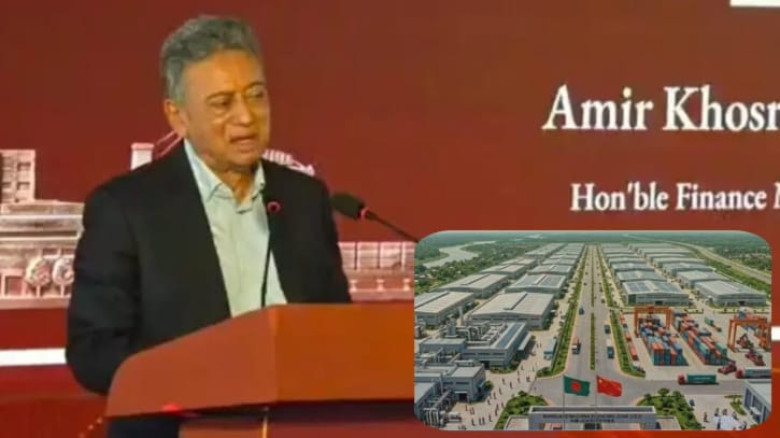

The investment in the Bangladesh-China Economic and
Industrial Zone (CEIZ) in Anwara, Chattogram, will exceed one billion US
dollars, said Finance and Planning Minister Amir Khasru Mahmud Chowdhury.
He said that this industrial zone, built on about 800
acres of land, will bring significant changes not only in Anwara but also in
the economy of the entire southern Chattogram. Along with industrialization, a
new supply chain, logistics, housing and service sectors will develop in the
region.
The Finance Minister made these remarks as the chief guest
at the groundbreaking, inauguration and foundation stone laying ceremony of the
Bangladesh-China Economic and Industrial Zone in Belchura area of Anwara on
Monday afternoon.
The Finance Minister said that currently there is a plan
to invest 500 million US dollars in the project. However, if all types of
investment, including infrastructure, are taken into account, the amount will
exceed one billion dollars. This project will play an important role in the
journey that the government has set to build a trillion-dollar economy by 2034.
He said that the government is working towards creating
one crore jobs. It is expected that more than one lakh people will be directly
and indirectly employed in the CEIZ.
The Finance and Planning Minister further said that once
the industrial zone is operational, a strong supply chain will be developed
around it. New opportunities will be created for transportation, logistics,
housing, service sectors and small and medium entrepreneurs. This will bring
new momentum to the economy of South Chattogram.
Home Minister Salahuddin Ahmed spoke as the special guest
at the event. Present at the event were State Minister for Land Mir Mohammad
Helal Uddin, Chinese Ambassador to Bangladesh Yao Wen, Bangladesh Economic Zone
Authority (BEZA) Executive Chairman Ashiq Chowdhury, CEIZ Chairman Wang
Benchian, China Road and Bridge Corporation (CRBC) President, Chattogram-13 MP
Sarwar Jamal Nizam, and representatives of the public and private sectors of
the two countries.
After almost a decade of waiting and administrative
complications, the construction of the Bangladesh-China Economic and Industrial
Zone has officially begun. According to project sources, the foundation of the
project was laid as a government-to-government initiative during Chinese
President Xi Jinping’s visit to Bangladesh in 2016. Later, the implementation
of the project was delayed for a long time due to various complications in the
selection of the developer, financing and infrastructure.
The implementation of the project gained momentum after
the approval of the ECNEC meeting on June 16. The total cost of the project is
estimated at 4,189 crore taka. Of this, 2,467 crore taka will be spent from
foreign loans and 1,722 crore taka from government financing. The
implementation period of the project has been set from January 2027 to December
2031.
Under the project, jetty link roads, main roads, water
reservoirs, gas transmission lines, central effluent treatment plants (CETP),
multipurpose jetties, solid waste collection centers, boundary walls and power
substations will be constructed.
The government expects that various high value-added
industries including textiles, ready-made garments, electronics,
semiconductors, telecommunication equipment, information technology,
pharmaceuticals, medical equipment, light engineering, chemicals and
automobiles will be developed in the CEIZ. This will further strengthen
export-oriented industrialization.
Amirul Haque, president of the Chattogram Chamber of
Commerce and Industry, said that the logistics facilities of the CEIZ are
favorable as it is close to the Karnaphuli Tunnel, Chattogram Port and Shah
Amanat International Airport. However, to attract investment, it is important
to ensure uninterrupted supply of gas, electricity and water, as well as make
customs and other services more simple and effective.