

Bangladesh's renewable energy ambitions are growing, but without predictable and accessible climate finance, the country's transition to a low-carbon future may remain out of reach.
As the world races toward a clean energy future, the conversation is often framed as an environmental necessity. For countries like Bangladesh, however, the green transition is far more than a climate agenda—it is an economic imperative, a development strategy, and increasingly, a matter of national resilience. Yet despite ambitious targets and policy reforms, one fundamental obstacle remains: financing.
Bangladesh has recently taken several encouraging steps to accelerate renewable energy adoption. The government has introduced tax incentives, customs duty exemptions on solar power equipment, and investment-friendly policies aimed at attracting private-sector participation. These initiatives signal a growing recognition that clean energy is essential for ensuring long-term energy security while meeting international climate commitments.
However, policy incentives alone cannot finance a transformation of this scale. The Cost of a Green Future Bangladesh's renewable energy sector remains significantly underdeveloped. According to government data, renewable sources contribute only around 5 percent of the country's total electricity generation capacity, far below the national target of generating 20 percent of electricity from renewables by 2030.
Achieving this goal requires far more than installing solar panels or wind turbines. It demands large-scale investment in transmission infrastructure, battery storage systems, smart grids, resilient urban planning, coastal protection, and climate-adaptive agriculture. Experts estimate that Bangladesh will require billions of dollars annually over the coming decades to build the infrastructure necessary for both mitigation and adaptation.
The challenge is not unique to Bangladesh. Across the developing world, climate-vulnerable countries face a widening gap between climate ambitions and available financing. While global climate finance flows have increased in recent years, they remain insufficient compared to actual needs.
According to the United Nations Environment Programme (UNEP), developing countries may require between $215 billion and $387 billion annually by 2030 for climate adaptation alone. Yet adaptation finance currently covers only a fraction of that demand. This disparity threatens to delay climate action precisely when urgency is at its highest.
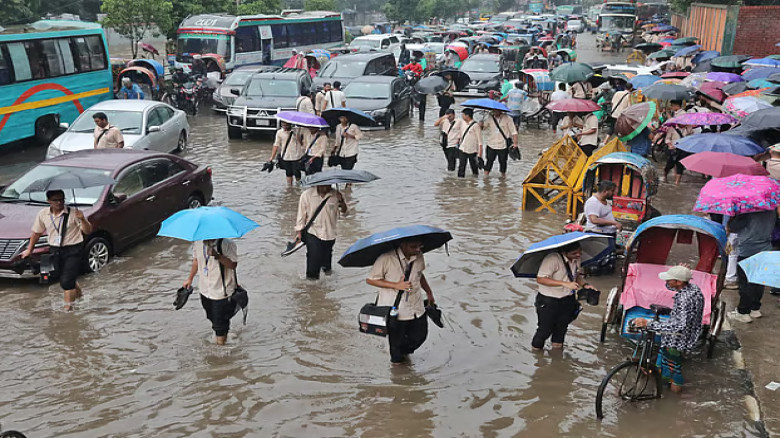
A Matter of Climate Justice Bangladesh contributes less than 0.5 percent of global greenhouse gas emissions, yet consistently ranks among the countries most vulnerable to climate change. Rising sea levels threaten coastal communities, cyclones continue to cause extensive economic losses, and increasingly frequent heatwaves are affecting public health, agricultural productivity, and food security.
The World Bank estimates that climate change could displace up to 13.3 million people internally in Bangladesh by 2050 if effective adaptation measures are not implemented. Such projections underscore the reality that climate change is no longer merely an environmental issue; it has become a socioeconomic and governance challenge. This reality raises an important question of fairness.
The industrialised nations that contributed the most to historical carbon emissions have repeatedly pledged financial support for developing countries through mechanisms under the Paris Agreement and successive UN climate conferences. Yet delivery has often fallen short of commitments. Although wealthy countries eventually met the long-promised $100 billion annual climate finance goal, experts argue that the amount remains inadequate relative to the scale of global need.
For climate-vulnerable countries, uncertainty over future financing creates serious planning challenges. Governments cannot design long-term renewable energy strategies when funding commitments remain unpredictable and subject to changing political priorities in donor nations.
Beyond Loans: The Need for Grants A growing concern is the increasing reliance on loans as a source of climate finance. While concessional loans may provide short-term support, they also add to the debt burden of countries already facing fiscal constraints.
Climate finance should not deepen vulnerability. Nations that contributed minimally to global warming should not be forced to accumulate unsustainable debt simply to protect their citizens from climate impacts largely created elsewhere.
For this reason, many experts advocate a greater emphasis on grants, highly concessional financing, and loss-and-damage support mechanisms. Such instruments better reflect the principle of climate justice and ensure that adaptation efforts do not come at the expense of economic stability.
Domestic Reforms Still Matter While international financing remains indispensable, Bangladesh must also strengthen its domestic enabling environment.
Lengthy approval processes, land acquisition challenges, inadequate transmission infrastructure, and regulatory bottlenecks continue to discourage investment in renewable energy projects. Improving coordination among government agencies, expanding public-private partnerships, and developing a robust pipeline of bankable projects will be crucial for attracting both domestic and foreign capital.
Investors are more likely to support projects that are technically sound, financially viable, and institutionally prepared for implementation. Climate finance, therefore, is not solely about securing funds—it is also about ensuring the capacity to use those funds effectively.
From Commitments to Action As global leaders continue to gather at climate summits and reaffirm their commitment to a sustainable future, the gap between promises and implementation remains evident. The scientific consensus is clear. Renewable technologies are becoming increasingly affordable. What remains uncertain is whether political commitments will be matched by adequate financial resources. For Bangladesh, climate finance is not a peripheral issue—it is the foundation upon which a successful green transition depends.
The country's renewable energy ambitions cannot be realised through declarations alone. They require sustained international solidarity, predictable long-term financing, and a global recognition that climate justice demands more than rhetoric.
The transition to a low-carbon future will not be won in conference halls. It will be won when climate finance becomes reliable, accessible, and proportional to the scale of the challenge. Until then, the promise of a just and inclusive green transition will remain an aspiration rather than a reality.