
Public health experts have called for ensuring the use of opaque and food-grade packaging at every stage of edible oil marketing to preserve Vitamin A in fortified edible oil and ensure its safety throughout the supply chain, from crude edible oil import to retail distribution. They stressed that transparent packaging should be phased out and replaced with opaque packaging to protect the nutritional quality of fortified edible oil, a press release said.
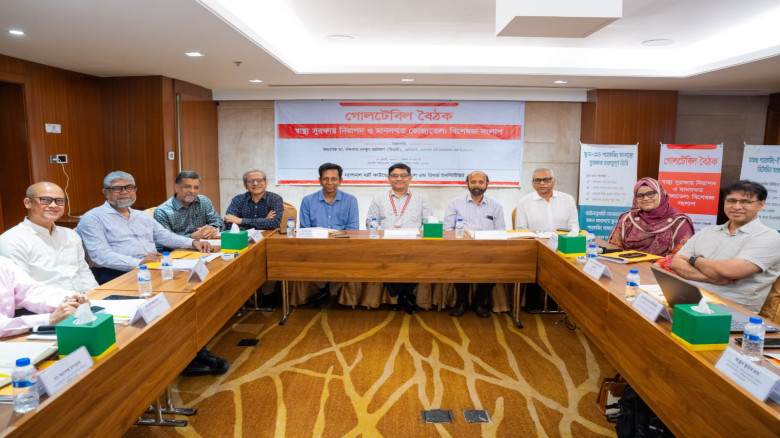
The call was made on Tuesday (7 July 2026) at a roundtable discussion titled “Safe and Quality Edible Oil for Better Health: An Expert Dialogue,” organized by the National Heart Foundation of Bangladesh at the Holiday Inn in Dhaka.
The dialogue was moderated by Mushtak Hasan Muhammad Iftikhar, Consultant of the Large Scale Food Fortification–Bangladesh Country Advocacy Project and Founding Chairman of the Bangladesh Food Safety Authority. The event brought together leading scientists, researchers, representatives of edible oil refineries, regulatory agencies, and policymakers.
The discussion highlighted that refining edible oil at temperatures above 230°C to achieve greater clarity increases the formation of trans fat, which poses significant health risks to consumers.
Speaking on the use of loose edible oil, Professor Moloy Kanti Mridha of BRAC University said that, according to the National Nutritional Surveillance conducted by his institution, 51 percent of households currently use packaged edible oil, while 49 percent still rely on loose edible oil.
Participants emphasized the urgent need to introduce opaque packaging to protect Vitamin A in fortified edible oil, noting that several viable opaque packaging options are already available in Bangladesh. Referring to food-grade packaging, S. M. Abu Sayeed, representative of the Bangladesh Standards and Testing Institution (BSTI), stated that food-grade certification for edible oil packaging must be obtained from the Product Certification Committee. However, the use of the food-grade symbol has not yet been made mandatory.
Professor Liaquat Ali, Chair of Pathikrit Foundation, underscored the importance of epidemiological evidence, noting that different types of edible oil have varying impacts on human health. He added that lifestyle, dietary habits, and changing cultural practices collectively influence public health and emphasized the need for more public health research in this area.
Sultan Alam, Joint Secretary of the Ministry of Industries, observed that DO dealers often transport edible oil in chemical drums that cannot be properly identified. He noted that discontinuing the use of such drums would help improve the quality of edible oil. He also urged research institutions to inform the relevant government authorities before publicly releasing research findings.
The dialogue concluded with several key recommendations, including strengthening coordination between refineries and regulatory agencies to resolve differences regarding the adoption of 100 percent opaque and food-grade packaging; regulating the use of loose edible oil in food processing industries as well as hotels and restaurants; issuing the “Guidelines for Hotels, Restaurants and Commercial Food Preparation Establishments” under Section 8 of the Vitamin A Fortification of Edible Oil Act, 2013; and ensuring heavy metal testing during port clearance of imported crude edible oil.
Among others, the event was attended by Brig. Gen. (Retd.) Professor Md. Younusur Rahman, Director of the National Heart Foundation of Bangladesh; Professor Dr. Sohel Reza Choudhury, Head of the Department of Epidemiology and Research, National Heart Foundation Hospital & Research Institute; Md. Kutubul Alam, Senior General Manager, Meghna Group of Industries; and Mohammad Shahidul Islam, General Manager (QC, QA and Compliance), TK Group.