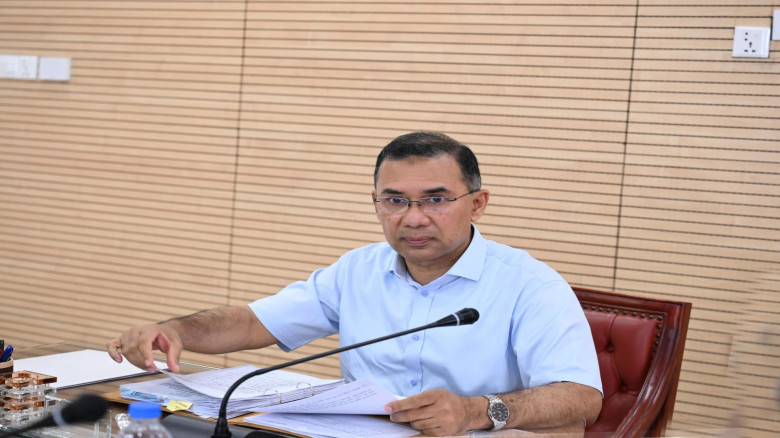


The creation of new jobs, new investment,
restoring sound law and order situation and political stability are major
challenges of the present BNP government, under the leadership of Prime
Minister Tarique Rahman.
The Bangladesh economy has been battered by the
massive corruption by the last Awami League government, corona pandemic,
Russia-Ukraine war, war in the middle-east and slowdown in global growth.
As the tension in the middle-east erupts again
as peace deal between USA and Iran seem teetering, manpower export of
Bangladesh to different countries posed 15 per cent negative growth during the
month of June compared to the previous month May, according to the data of
Bureau, Manpower, Employment and Training (BMET)
Bangladesh exported a total of 51,305 workers
in the month of June as against 60,155 workers in the month of May.
BMET data show that 94,189 workers received
overseas employment clearance in January,
65,634 workers in February 2026, followed by 44,658 in March, 48,859 in
April and 60,119 in May, according to
Bureau, Manpower, Employment and Training (BMET
The USA-Israel imposed war on Iran has hit the
overseas employment of Bangladesh
creating an uncertainty in the overseas job market, said a leader of
Bangladesh Association of International Recruitment Agencies (BAIRA).
The manpower export during the last three
months plummeted sharply with USA and Iran at loggerhead over ending the war
and ensuring peace and stability in the region.
Bangladesh exported a total of 95,092 workers
in January, 65,634 workers in February, 44629 workers in March and 43,490
workers in April to overseas countries.
Saudi Arabia remained the top destination in
both months, though numbers declined significantly. Labour recruiters noted that low-skilled
workers continue to dominate Saudi Arabia and other Middle Eastern routes.
Meanwhile, the USA-Israel imposed war on Iran
has hit the overseas employment of Bangladesh
creating an uncertainty in the overseas job market, said a leader of the
Bangladesh Association of International Recruitment Agencies (BAIRA).
The creation of jobs in the local and
international markets is in a shambles with growing energy prices shaking the
global economic growth including Bangladesh, said a BAIRA leader.
Saudi Arabia remained the top destination in
both months, though numbers declined significantly. Labour recruiters noted that low-skilled
workers continue to dominate Saudi Arabia and other Middle Eastern routes.
Shamim Ahmed Chowdhury Noman, former secretary
general of the Bangladesh Association of International Recruiting Agencies,
said: "The payment structure is still between Tk25,000 and Tk30,000. Most
Bangladeshis are employed as cleaners, construction workers, and housemaids.
The government has yet to renegotiate salaries with destination countries to
ensure better earnings for our workers."
The BNP government is counting millions of taka
in the energy subsidies to maintain economic engine of the economy
Meanwhile, Bangladesh's export earnings have
declined in the 2025-26 fiscal year despite a sharp rebound in June, with
receipts falling 0.58 per cent from the previous year to $48 billion.
The annual export figure also fell nearly 13
per cent short of the government's target of $55 billion, as per a bdnews24.com
report.
According to the latest data published by the
Export Promotion Bureau (EPB) on Thursday, export earnings stood at $48.28
billion in FY25.
The overall decline could have been much
steeper had exports not rebounded strongly in June.
Exporters earned $4.20 billion in June, up
25.91 per cent from $3.334 billion in the same month a year earlier.
The EPB data showed that export earnings had
declined for eight consecutive months before recovering in April.
Exports rose to $4.01 billion in April, nearly
33 per cent higher than in the corresponding month of the previous year.
However, the momentum did not continue in May.
Export earnings in May stood at $4.40 billion,
down 7.07 per cent from May of the previous fiscal year.
Analysis of the EPB data indicates that the
overall negative export growth in FY26 was mainly driven by weaker performance
in the ready-made garments sector, the country's largest export industry.
Ready-made garment exports earned $38.70
billion during the fiscal year, down 1.64 per cent from a year earlier.
Meanwhile,
Bangladesh continues to witness robust remittance inflows in the current
fiscal year, with expatriate Bangladeshis sending over $35 billion during the
period from July 2025 to June 23, 2026, marking an impressive 17.8 percent
growth compared to the corresponding period of the previous fiscal year.
According to the latest data from Bangladesh
Bank released today, remittance inflow reached $35 billion till June 23 of
FY2025-26, up from $29.72 billion received during the same period of FY2024-25.
On June 23, 2026, expatriates sent $87 million
through official banking channels, reflecting the continued contribution of
overseas workers to the country's foreign exchange reserves.
During the first 23 days of June, remittance
inflow totalled at $2,238 million.
Meanwhile, the economic projections of the
Bangladesh Bank , government , World Bank and Asian Development Bank show that
Bangladesh will struggle to attain 5-6 per cent growth in the 2026-27 fiscal
year…..
The World Bank projects Bangladesh's real Gross
Domestic Product (GDP) growth to be 4.6% for the 2026-27 fiscal year. This
forecast reflects mounting economic headwinds, including persistent inflation,
sluggish private sector activity, and global uncertainties. ………….
The World Bank projects Bangladesh's real Gross
Domestic Product (GDP) growth to be 4.6% for the 2026-27 fiscal year. This
forecast reflects mounting economic headwinds, including persistent inflation,
sluggish private sector activity, and global uncertainties.
The Asian Development Bank (ADB) projects
Bangladesh's Gross Domestic Product (GDP) to grow by 4.7% in the fiscal year
2026–27 (FY2027), an acceleration from the 4.0% growth estimated for FY2026.
This recovery is supported by easing political uncertainty and rebounding
consumption and investment
Bangladesh Bank has projected the country's
economy to grow by 6.1% in FY27, lower than the government's 6.5% target set in
the national budget, while keeping key policy interest rates unchanged in an
effort to rein in inflation.
The forecast was unveiled in the central bank's
Monetary Policy Statement (MPS) for the July-December period of FY27, released
today (30 June).
According to provisional estimates by the
Bangladesh Bureau of Statistics (BBS), the economy grew by 4.14% in FY26,
recovering from 3.49% in the previous fiscal year.
The MPS said the government's fiscal strategy
for FY27 combines growth-supportive measures with fiscal discipline,
prioritising development spending alongside tax reforms, expenditure
rationalisation, targeted subsidies and expanded social protection programmes.
"The new government has enacted
growth-supportive but fiscally prudent expansion focused on development
expenditure as its fiscal stance for FY27," the statement said.
However, policy-makers and BAIRA leaders also
see a positive scenario out of war in the middle east. The oil-rich countries
are most likely to rebuild their infrastructures, damaged in the war requiring
thousands of workers. The recontraction works in the Gulf countries can give a
boost overseas job markets after the USA-Israel imposed war in the middle -east ends.
A leader of Bangladesh Association of
International Recruiting Agencies said that export of manpower to different
countries is expected to get momentum, provided the USA and Iran sealed a peace
deal
Meanwhile, Dr. Khalilur Rahman held meeting diplomats of Gulf countries at a
breakfast meeting on Tuesday morning at
the state guest House Padma and seek their cooperation on energy and employment
of Bangladeshis in the region…….
Policy Exchange of Bangladesh President M
Masroor Reaz said creating momentum in job creation, investment and export are
important in the national economy.The government has also major challenges to
refix banking system and ensuring the energy security.
The writers are senior Journalist.