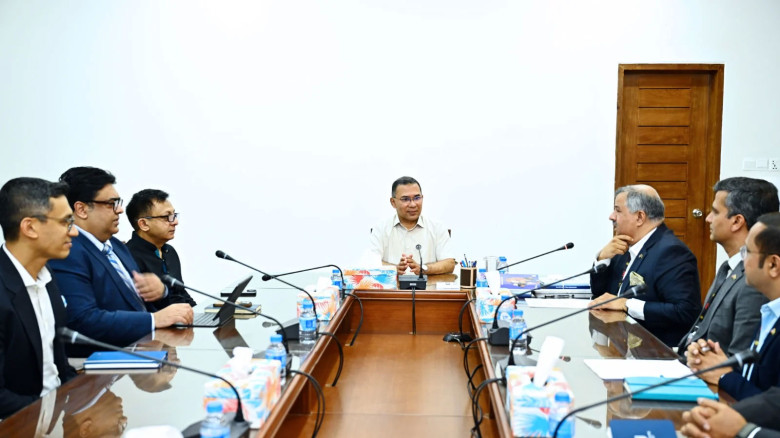


DHAKA : Chinese Ambassador to Bangladesh Yao Wen today described Prime Minister Tarique Rahman's just-concluded visit to China as a "complete success", saying it has injected strong momentum into the growing Dhaka-Beijing relations.
"It's a complete success. It's a milestone in Bangladesh-China relations which reached a new strategic height," he told reporters at the Chinese Embassy while highlighting the outcomes of the visit.
The Ambassador said a new level of trust has developed between the two countries following the visit.
He describef the proposed Bangladesh-China-Myanmar Economic Corridor as a new strategic opportunity.
Responding to a question, Yao said the idea of building an economic corridor is not new as discussions on the Bangladesh-China-India-Myanmar (BCIM) Economic Corridor had taken place around 15 years ago, but no progress was made.
He said China is determined to build the Bangladesh-China-Myanmar Economic Corridor for broader regional cooperation.
The Ambassador said China remains open to India and other countries joining the initiative, but those countries need to make their own decisions.
Yao said the Teesta River Comprehensive Management and Restoration Project (TRCMRP) was highlighted during the visit as the livelihoods of millions of people are linked to it.
"Teesta is a Bangladesh project. It's your project," he added.
He also referred to the key achievements of the Prime Minister's visit, including the launch of a strategic dialogue at the foreign minister level and exploration of a "2+2" dialogue mechanism covering diplomacy and defence.
Talking about defence cooperation, Yao said Bangladesh-China cooperation is comprehensive and defence cooperation is part of it.
He, however, declined to comment on any specific defence purchase.
Director at the Chinese Embassy Zhang Jing and Counselor Song Yang were also present.
During Prime Minister Tarique Rahman’s Beijing visit, Bangladesh and China signed 17 bilateral instruments, including MoUs, agreements, a joint action plan and an agricultural trade protocol, to further strengthen bilateral relations.
The instruments include an MoU on promoting the implementation of the Global Development Initiative (GDI), an MoU on exchanges and cooperation between the Bangladesh Nationalist Party (BNP) and the Communist Party of China, and an agreement on development cooperation between Bangladesh and China.
Other documents include an agreement on the expansion and modernisation of the Mongla Port Facilities Project, an MoU on joint implementation of the 2026 Human Resources Development Cooperation Programme, and an agricultural trade protocol on phytosanitary requirements for exporting fresh jackfruit from Bangladesh to China.
The two sides also signed several media cooperation documents, including MoUs involving China Media Group (CMG), Bangladesh Television (BTV), Xinhua News Agency, Bangladesh Sangbad Sangstha (BSS), and the Ministry of Information and Broadcasting.
The signed documents also include an agreement on cooperation in Chinese language education, an MoU on strengthening cooperation in vocational education, an MoU on promoting investment cooperation in green development, an export promotion joint action plan to enhance Bangladesh's export capacity, an industrial development and land lease agreement for the Chattogram Economic Industrial Zone (CEIZ), an MoU on cooperation for the development of the China-Bangladesh Mongla Port Economic Zone, and an investment cooperation agreement with the China Council for the Promotion of International Trade (CCPIT).
Prime Minister Tarique Rahman returned home from Beijing on Friday after wrapping up his first overseas tour, which included visits to Malaysia and China.