
Print Date : August 24, 2026 || Published : June 15, 2026
Sabet Engine aims to lift poor out of poverty
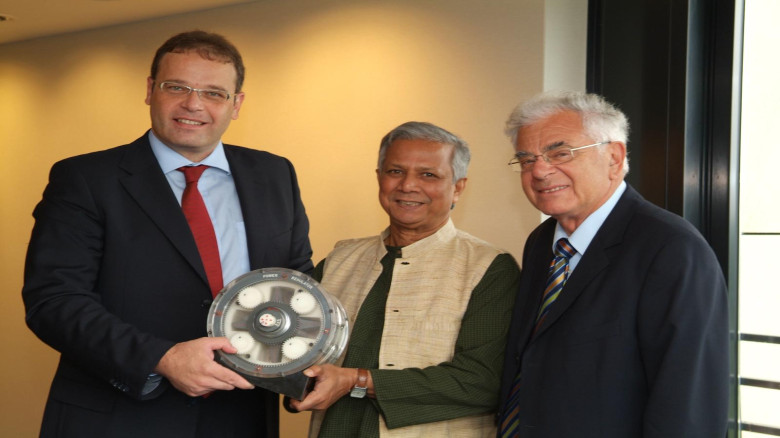
After years of dedicated research and development, Dr. Sabet Consulting GmbH has achieved a breakthrough that its creators believe could change the lives of poor entrepreneurs around the world. The Sabet Advanced Motor, known as SAM, is now ready to move into production, and a new social business will soon be established to make it a reality, a press release said.
The vision behind SAM was simple but radical. Build an engine that can be sold at half the price of conventional engines, run on virtually any fuel available to a poor entrepreneur, and require minimal maintenance.
The original inventors, brothers Hushang and Hushmand Sabet, set out with the explicit goal of developing an “engine to lift people out of poverty.” To live up to that vision, they knew the engine had to be fundamentally different from anything that came before. Not an improvement, but a reinvention, following in the footsteps of the Otto engine and the Wankel engine. That is exactly what has been achieved. SAM requires only a fraction of the parts needed by conventional engines, making it significantly cheaper to manufacture, more compact, more robust, and far easier to adapt to a wide variety of fuels. One of the most renowned experts who oversaw its development called it “an invention of the century.”
The Story Behind the Engine
Prof. Muhammad Yunus first met Hushmand Sabet in 1997, when both were honored with the Club of Budapest International’s “Planetary Consciousness Award” at Frankfurt’s Paulskirche. The laudator, Dr. Lothar Späth, noted even then that the combination of these two laureates’ ideas and work could mean nothing less than “the beginning of a truly global eco-social market economy.”
Sabet had followed Prof. Yunus’s work closely, through German newspapers and television interviews, and was struck by his core message. The poor are bypassed by institutions, policies, and technologies alike. Technologies are designed to make rich people richer. The poor rarely benefit. But technology can be designed differently, to help poor people produce more, with less physical labor.
This conviction became central to the SAM project. Over the years, the Sabet family consulted Prof. Yunus repeatedly to understand what features an engine would need to genuinely serve the poor. In 2008, Hushmand and his son Hafez Sabet presented the basic version of SAM to Prof. Yunus for the first time in Berlin. Due to Hushmand Sabet’s illness and death in 2016, further development was delayed. Starting in 2020, the team around Hafez Sabet at Dr. Sabet Consulting resumed active development with further improvements. In 2025, Hafez Sabet visited Bangladesh and participated in Social Business Day in Dhaka as a key speaker, and the milestone was celebrated together.
The Sabet family has been known for over five decades for pioneering inventions and socially innovative initiatives. Hafez Sabet’s master’s thesis on the global debt crisis was recognized as groundbreaking by Nobel laureates in economics. Peter Spiegel, futurist and founder of the WeQ Institute, has supported the family’s work across multiple projects over the years.
A Foundation and a Social Business
Dr. Sabet Consulting and Prof. Yunus have agreed to establish a Germany-based foundation, the Sabet-Yunus Foundation, on whose board both will serve alongside others. This foundation will hold the patent license and grant it to social businesses in Bangladesh, enabling local production and marketing of SAM engines under license. The foundation will be administered by the WeQ Institute and is envisioned as a platform for social innovation, research, education, development cooperation, and social entrepreneurship.
Advancing Clean Energy in Bangladesh
Building on a Memorandum of Understanding signed by Dr. Sabet Consulting GmbH, Grameen Healthcare Trust, and WeQ Institute gGmbH, efforts are now underway to establish a social business joint venture focused on clean energy production in Bangladesh through SAM technology. Partners have reviewed both the SAM technology and the CELINE (Clean Ethanol Logistics Improving Natural Environment) concept. Discussions have addressed technical and commercial assessments, including feedstock sources, regulatory considerations, market conditions, environmental impact, and long-term financial sustainability.
A pilot program to produce a test series of at least 200 SAM units in Bangladesh has been agreed upon, to be conducted under controlled conditions and at sufficient scale to yield statistically meaningful results.
SAM is designed as a fuel-agnostic system capable of producing mechanical, electrical, and cooling energy across a wide range of applications, making it particularly relevant for addressing energy challenges in emerging economies.
The partners believe that, if successfully validated and implemented, this initiative can advance clean energy solutions, strengthen local capacity, and demonstrate replicable social business models in Bangladesh and beyond.
Copyright © 2026 Daily Capital Views. All Rights Reserved.
 প্রিন্ট করুন
 সেভ করুন