
Tourism Fair 2026 concludes focusing on AI in tourism
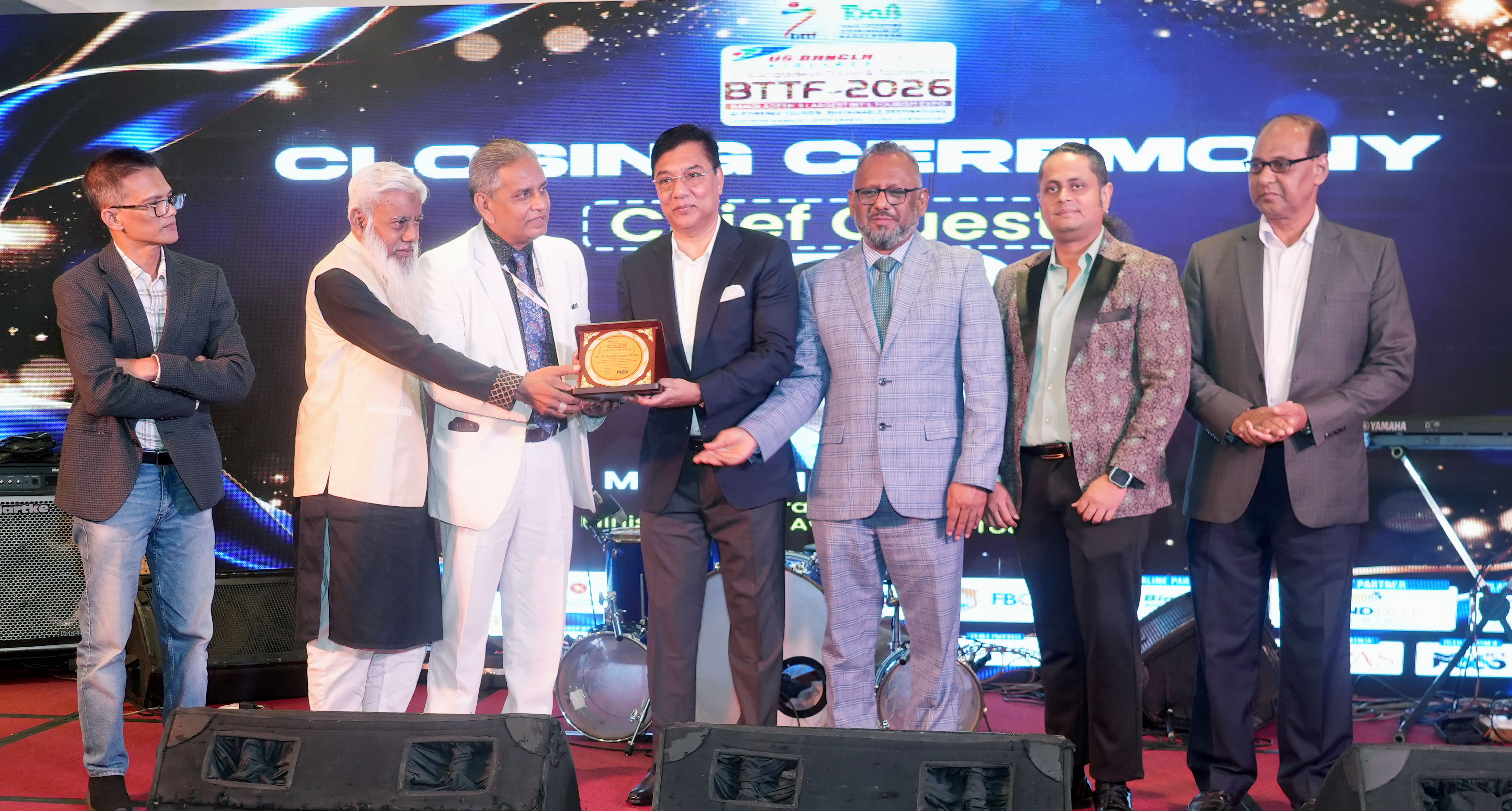
Business worth BDT 43 crore conducted over three days; visitor presence exceeds 45,000
The Bangladesh Travel and Tourism Fair (BTTF) 2026 has concluded successfully, emphasizing how Artificial Intelligence can be utilized more efficiently, reliably, and inclusively in tourism management while balancing the social, environmental, and economic aspects of sustainable tourism. Organized by the Tour Operators Association of Bangladesh (TOAB), the three-day fair saw total sales and commercial transactions worth approximately BDT 43 crore. Additionally, nearly 45,000 visitors attended the event during this period. Biman Bangladesh Airlines and US-Bangla Airlines received a tremendous response in ticket sales at this year's fair.
The three-day fair came to an end yesterday, Saturday (31
October), through a closing ceremony held at the Crowne Plaza Dhaka Airport.
The Chief Guest at the closing ceremony was M. Rashiduzzaman Millat, Minister
for Civil Aviation and Tourism. Dr. Nurun Nahar Chowdhury, NDC, Secretary of
the Ministry of Civil Aviation and Tourism; Dr. Nazneen Kawsher Chowdhury,
Executive Chairman (Secretary) of the National Skills Development Authority;
Md. Shamimuzzaman, Chairman of Bangladesh Parjatan Corporation; Barrister
Mutasim Billah Faruqui, CEO of the Bangladesh Tourism Board; Kaizar Sohel
Ahmed, Managing Director and CEO of Biman Bangladesh Airlines; GM Azizur
Rahman, Additional IGP of Bangladesh Tourist Police; the President and leaders
of TOAB; alongside local and international representatives from the tourism
sector, also attended to the event.
Delivering his speech as Chief Guest at the closing
ceremony, M. Rashiduzzaman Millat, Minister for Civil Aviation and Tourism
said, “Bangladesh’s tourism sector holds immense potential. To further improve
the tourism sector’s communication infrastructure, we have expanded the
aviation sector. Meanwhile, we have already adopted a master plan to enrich
tourism, under which hotels and resorts will be operated with the support of
regulations, technology, and sustainable planning. We have installed solar panels
at resorts to address power shortages and arranged training for the younger
generation through the National Hotel and Tourism Training Institute (NHTTI).
Alongside it, the use of technology must be increased to ensure destination
management, tourist safety, waste management, environmental monitoring, and
emergency services. In particular, there is an opportunity to introduce digital
information services and smart monitoring systems at our tourist spots. Through
the proper application of technology and the effective enforcement of
regulations, it is possible to build more responsible and sustainable tourism
destinations.”
Prior to the closing ceremony, a seminar was organized at
the Bangladesh-China Friendship Conference Center (BCFCC), the main venue of
the fair. Speakers at the seminar, titled ‘AI for Sustainable Tourism
Operation’, discussed the potential of Artificial Intelligence integration and
sustainable development in the tourism sector.
Discussants noted that AI should be applied to enhance
tourist searches, booking management, dynamic pricing, itinerary generation,
hospitality services, and overcoming language barriers. Furthermore, the
seminar highlighted the role of technology in controlling destination
overcrowding, promoting local businesses, saving aviation fuel, enabling
data-driven decision-making, and mitigating the environmental impact of
tourism.
Speakers further stated that the effective application of AI
in the tourism sector requires adequate and reliable data, skilled personnel,
robust infrastructure, and strong public-private partnerships. At the same
time, ensuring the use of technology while preserving the human touch, warmth,
hospitality, and cultural experience will remain both the primary challenge and
opportunity for sustainable tourism development.
The seminar was chaired by Syed Safat Uddin Ahmed, 1st Vice
President of TOAB, with the keynote paper presented by Syed Sajjat Hossain
Mahmud, CEO of Swadeshi Communications. Additionally, Dr. Md. Anowar Hossain
Bhuiyan, Associate Professor of Faculty of Business Studies, National
University Bangladesh and Mahbub Parvez, Associate Professor of Department of
Tourism and Hospitality Management, Daffodil International University,
participated as discussants. The seminar was moderated by Akhtaruzzaman Kabir,
Chairman of the Dhrubotara Youth Development Foundation (DYDF).
Emphasizing that sustainable tourism is not limited to the
tourism industry alone, discussants stated that it is part of a coordinated
effort across all sectors linked to the economy, environment, and society. AI
offers opportunities to streamline tourist queries, bookings, pricing models,
itinerary creation, hospitality management, and translation barriers. Analyzing
sufficient tourism-related data enables more effective travel planning,
increases tourist trust, and lowers operational costs as well as environmental
footprints.
Simultaneously, AI-driven flight route planning helps reduce
fuel consumption, while analyzing integrated data such as weather patterns,
weekends, booking volumes, and transportation networks can improve destination
management. The seminar also highlighted a step-by-step framework for AI
deployment in tourism: problem identification, relevant data collection, pilot
testing of tools, evaluating costs and environmental impacts, and scaling
successful initiatives.
The economic potential, job creation, and skill development
aspects of the tourism sector were also highlighted at the seminar. AI can
assist in analyzing tourism’s contribution to GDP, tourist demographics, and
travel trends. However, skilled human resources, sound infrastructure,
effective policies, and public-private partnerships remain essential for the
sector’s sustainable growth. AI can also play an effective role in drafting
travel plans that balance the three pillars of sustainable tourism: social, environmental,
and economic. To prepare the tourism sector for the future, speakers urged a
balanced integration of human experiences with AI capability.
National and international tourism representatives and
organizations from 20 countries including Nepal, India, Singapore, Maldives,
Philippines, Turkey, UAE, China, Sri Lanka, Pakistan, Thailand, Brunei, Saudi
Arabia, Malaysia, and Azerbaijan participated in this 14th edition of the fair.
Malaysia, Pakistan, Philippines, and Nepal served as partner countries for this
edition, while US-Bangla Airlines was the title sponsor.
Additionally, the fair's official partners included Biman
Bangladesh Airlines as Airline Partner, Crowne Plaza Dhaka Airport as Platinum
Hospitality Partner, Sabre as GDS (Global Distribution System) Partner, OPAS
Communications Ltd. as PR Partner, M360ICT as Technology Partner, Convoy
Service as Transport Partner, Maestro as Digital Partner, Panorama PC Creators
and Ruchi as Audio-Visual Partners, and BCFCC as Venue Partner.
Under the theme ‘AI Powered Tourism, Sustainable
Destination,’ this edition of BTTF highlighted Bangladesh’s tourism potential
on the global stage while fostering business connections, knowledge exchange,
and new investment opportunities among domestic and international stakeholders.
It also emphasized continuing coordinated efforts across public-private
partnerships, modern technology integration, skilled human resource
development, and environmental conservation to advance the tourism sector.
Copyright © 2026 Daily Capital Views. All Rights Reserved.
 প্রিন্ট করুন
 সেভ করুন