
Print Date : August 24, 2026 || Published : August 20, 2026
NSU SHSS holds study circle on riverine history, geopolitics
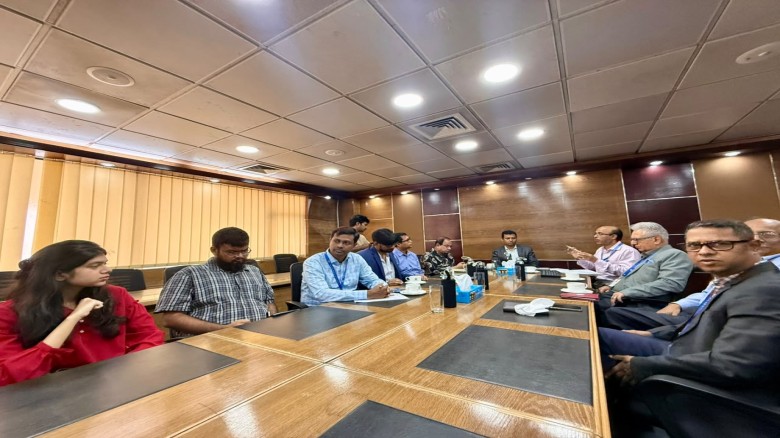
North South University School of Humanities and Social Sciences (NSU SHSS) hosted another session of the NSU SHSS Study Circle on 20th August. The program featured Dr. Mohammed Abdul Baten, Assistant Professor in the Department of Political Science and Sociology at North South University. He presented a talk on the book titled “The Range of the Year: A Riverine History of Empire Across China, India and Southeast Asia” by environmental historian Dr. Iftekhar Iqbal. Prof. Md. Rizwanul Islam, Dean of the School of Humanities and Social Sciences, delivered the opening remarks. Md Lokman Hussain, the Senior Lecturer of the Department of Law, moderated the study circle, a press release said.
In his opening remarks, Professor Md. Rizwanul Islam stated that programs like the NSU SHSS Study Circle play a vital role in building intellectual bridges across the school. Expressing his gratitude to the Department of Political Science and Sociology for conceiving the idea, he shared that the school aims to host more sessions to spark and accelerate these meaningful academic discussions. He also stated that if the control and management of rivers become politically driven, it could lead to significant ecological and biodiversity disasters.
Dr. Baten noted that Dr. Iqbal presents rivers not merely as bodies of water but as vital forces deeply connected to human life, biodiversity, and ecology. He explained that the book focuses on six major rivers: the Brahmaputra, Yangtze, Salween, Mekong, Red, and Irrawaddy. All six of these rivers are interconnected and originate from the Tibetan Himalayas. Quoting Dr. Iqbal, Dr. Baten highlighted that imperial powers colonizing Asia had to negotiate with local and indigenous populations, as these groups held greater control over the rivers. In his presentation, Dr. Baten placed particular focus on the Brahmaputra River, highlighting its historical role as a vital trade route. Beyond facilitating commerce, he emphasized that the river served as a major corridor for promoting cultural and religious exchanges across the region. He also referred to the construction of dams in the region, such as the Farakka Barrage, which severely impacts the people of downstream nations like Bangladesh.
The presentation was followed by a lively and engaging Q&A session. Alongside other key events such as the Colloquium Series for undergraduate students, graduate students, and alumni, as well as the SHSS Distinguished Lecture and Webinar Series, this initiative significantly enhances the school’s commitment to academic excellence. The organizers aim to host more such events to provide robust platforms for collaborative engagement between faculty and students.
Copyright © 2026 Daily Capital Views. All Rights Reserved.
 প্রিন্ট করুন
 সেভ করুন