
NSU Center for Legal Research hosts Talk
DHAKA : North South University Center for Legal Research
(NSU CLR), in collaboration with the Department of Law, hosted a talk titled
“Bangladesh and the Refugee Convention: Through a Socio-Legal Lens” on 13
August 2026. The session brought together faculty, researchers, and students to
critically examine Bangladesh’s historical and legal relationship with
international refugee law through a socio-legal perspective.
The programme started with opening remarks from Prof.
Ishtiaque Ahmed, Professor of Law and Chair, Department of Law, who welcomed
the attendees and underscored the significance of examining Bangladesh’s
refugee protection practices at the intersection of law and society.
In her keynote address, Naureen Rahim, Doctoral Research
Fellow at the Department of Criminology and Sociology of Law, University of
Oslo, situated Bangladesh as one of the world’s major refugee-hosting
countries, with a long history of forced displacement spanning distinct
categories such as the Urdu-speaking minorities, Rohingya refugees, and urban
refugees, despite the absence of a national refugee law and Bangladesh’s
continued non-accession to the 1951 Refugee Convention and its 1967 Protocol.
Speaking as part of her doctoral research under the BEYOND project —
“Protection without ratification? International refugee law beyond state
parties to the 1951 Refugee Convention” — she examined how Bangladesh, like
other non-signatory states, responds to globally established refugee norms
through local practice.
. Rahim outlined
findings drawn from two rounds of fieldwork conducted in Bangladesh in 2023 and
2025, including 46 interviews carried out in Cox’s Bazar, alongside archival
research at the UNHCR Archives in Geneva and the National Parliament Library in
Dhaka. She shared insights from her article, “A Twist in the Tale of Asian
Exceptionalism: Bangladesh’s ‘Near Accession’ to the 1951 Refugee Convention,”
and outlined forthcoming work examining friction between UNHCR and the
International Organization for Migration (IOM) in refugee governance, as well
as how local courts and legal aid providers have interpreted international
refugee law in Bangladesh.
The keynote address was followed by an open
question-and-answer session, during which attendees engaged directly with the
themes raised.
In his remarks as Session Chair, Prof. Md. Rizwanul Islam,
Professor of Law and Dean, School of Humanities and Social Sciences, critically
examined Bangladesh’s historical stance on international refugee law and its
non-accession to the 1951 Refugee Convention. He proposed that the Ershad
regime’s potential accession was largely a maneuver to secure external
political legitimacy under international pressure rather than a genuine
commitment to refugee rights. Evaluating domestic court rulings such as the
Farruk and Ramroo cases, he highlighted how local courts incoherently
prioritized domestic constitutional provisions over international customary
refugee standards. He further pointed to global geopolitical hypocrisy, arguing
that Western nations seek to shift asylum burdens onto developing countries
while major powers selectively manipulate international law to suit their
strategic interests. He concluded by observing that legal protection and aid
for refugees in Bangladesh stem primarily from non-state legal organizations
rather than formal state-sponsored frameworks.
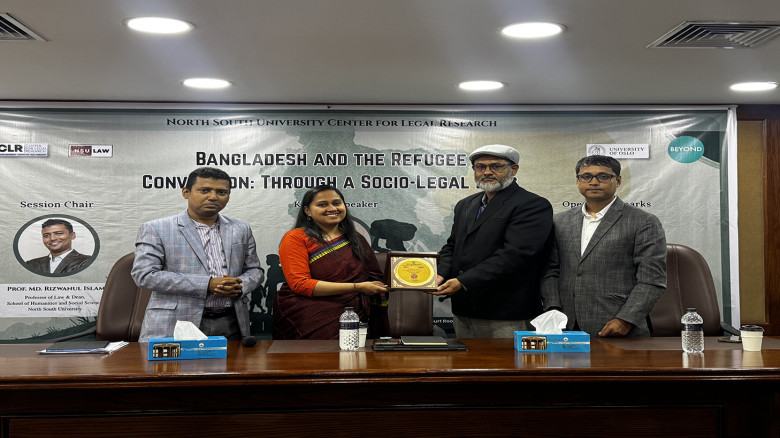
The seminar concluded with a memorable crest-presenting
ceremony, honoring the keynote speaker as a token of appreciation and respect
for her invaluable contributions.
Through this seminar, the North South University Center for Legal Research reaffirmed its continuing commitment to fostering scholarly engagement with pressing questions of law and social policy, and to strengthening academic collaboration on refugee protection and international human rights law between Bangladesh and international research partners such as the University of Oslo.
Copyright © 2026 Daily Capital Views. All Rights Reserved.
 প্রিন্ট করুন
 সেভ করুন