
Print Date : August 24, 2026 || Published : August 13, 2026
BRAC University hosts post budget dialogue on economic priorities
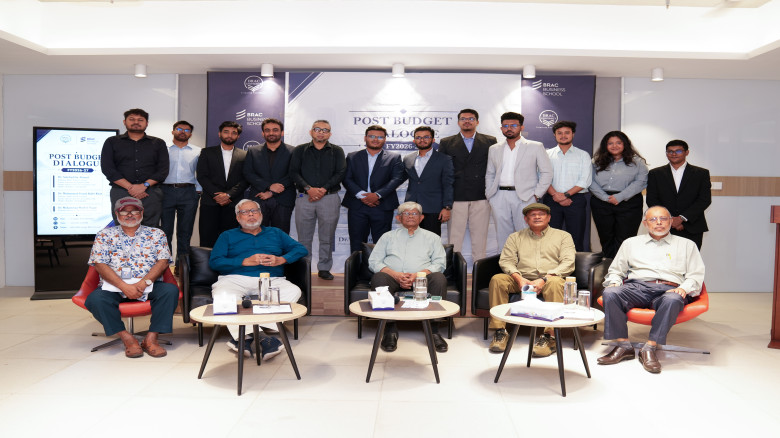
BRAC University hosted a dialogue on Bangladesh’s national budget for FY 2026–27 at its Merul Badda campus on Thursday, bringing together economists, academics, students and professionals for an academic discussion on the country’s economic priorities and challenges surrounding budget implementation, a press release said.
Organized by BRAC Business School (BBS), the dialogue examined a range of issues, including banking sector stability, revenue mobilization, inflation, taxation, energy security, public expenditure, investment and employment generation.
Professor Salehuddin Ahmed of BBS, former governor of Bangladesh Bank and former adviser to the Government of Bangladesh, identified restoring confidence in the banking sector as an important priority.
He highlighted the importance of strengthening the financial sector through appropriate institutional reforms, alongside improvements in revenue collection, tax administration, accountability and expenditure management. He also emphasized the need to maintain adequate focus on priority areas including health, education and social protection.
Professor Salehuddin observed that the effectiveness of the national budget would ultimately depend on the quality and consistency of its implementation.
Delivering the keynote address, Professor M Fouzul Kabir Khan of BBS, also Director of BRAC University’s Centre for Energy and Logistics (CEL) and a former adviser to the Government of Bangladesh, discussed inflation, taxation, energy security and fiscal management.
He emphasized greater efficiency and accountability in the tax system and stronger measures to improve tax compliance and broaden the country’s revenue base.
Discussing energy security, Professor Fouzul highlighted the importance of carefully balancing immediate requirements with longer-term economic and energy considerations. He underscored the need for well-considered policy responses that address current challenges without creating additional pressures elsewhere in the economy.
The discussion also covered investment, employment generation, institutional capacity and evidence-based policymaking. Speakers highlighted transparency, accountability, effective institutions and sound implementation as important factors in achieving the objectives outlined in the national budget.
Moderating the session, BBS Dean Professor Mohammad Mujibul Haque said the dialogue provided students and professionals with an opportunity to engage with experienced economists and policymakers and to develop a deeper understanding of how national budgets influence Bangladesh’s economic and development trajectory.
The programme concluded with an interactive question-and-answer session, during which participants exchanged perspectives on inflation, financial sector reforms, taxation, energy security, investment and Bangladesh’s longer-term economic outlook.
The dialogue was organized as part of BRAC University’s commitment to fostering informed academic discussion, critical inquiry and evidence-based engagement on issues of national development.
Copyright © 2026 Daily Capital Views. All Rights Reserved.
 প্রিন্ট করুন
 সেভ করুন