
Print Date : August 24, 2026 || Published : August 4, 2026
Bangladesh-Korea CEPA aims for export growth
Signed on August 4, 2026, the Bangladesh-Korea Comprehensive Economic Partnership Agreement (CEPA) marks a transformative milestone in bilateral trade relations. Designed to protect and multiply Bangladesh’s trade capacity post-LDC graduation, the agreement secures targeted tariff preferences and preferential market access across key export sectors. Under the deal, 97 percent of Bangladesh’s goods will get preferential market access to South Korea, while 87 percent of Korean goods will get similar access to Bangladesh, a press release said.
The agreement arrives at a pointed moment: Bangladesh’s exports to South Korea fell 9 percent year-on-year in FY2025-26, according to EPB data, making CEPA less a bonus on top of steady growth and more a deliberate course-correction for a bilateral trade relationship that has been losing ground.
Overview of Bangladesh’s Exports to South Korea
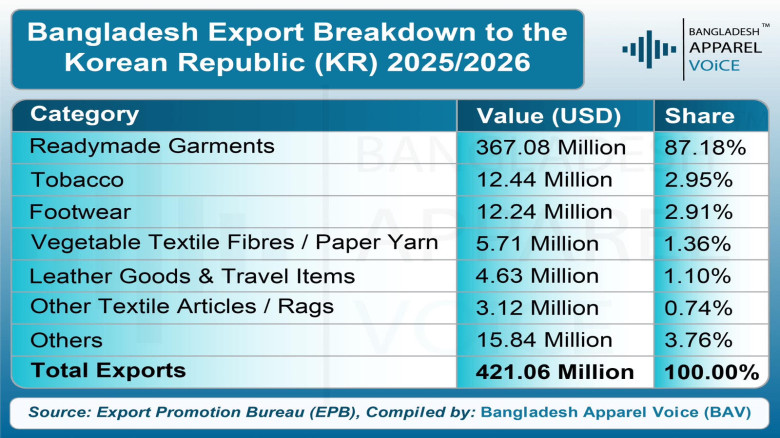
Total Bangladesh exports to South Korea stand at US$ 421.06 million, anchored heavily by the apparel industry alongside promising diversification categories:
Readymade Garments (nearly 87% of total exports): Apparel, not knitted or crocheted (HS 62): US$ 199.95 million (47.49%) Apparel, knitted or crocheted (HS 61): US$ 167.13 million (39.69%) Tobacco and manufactured substitutes: US$ 12.44 million (2.95%) Footwear and parts: US$ 12.24 million (2.91%) Other vegetable textile fibers & paper yarn: US$ 5.71 million (1.36%) Leather goods, handbags, and saddlery: US$ 4.63 million (1.10%) Other made-up textile articles & rags: US$ 3.12 million (0.74%) Others: US$ 15.84 million (3.76%)
Market Potential & Strategic Impact South Korea represents a massive, multi-billion-dollar import market—having imported US$ 12.98 billion worth of apparel from the global market (accounting for 2.98% of world imports as per WTO data). Despite this immense potential, historical trade volumes from Bangladesh have been constrained by:
A structural mismatch between Korea’s high-end, trendy fashion preferences and Bangladesh’s historical focus on basic garment lines.
Intense regional competition and deeply integrated supply chains involving nearby manufacturing hubs like China and Vietnam.
Administrative bottlenecks due to the previous absence of a comprehensive bilateral trade framework.
The CEPA Advantage The newly enacted CEPA directly dismantles these historical trade friction points. With 97 percent of Bangladesh’s goods now securing preferential market access to South Korea — a near-total removal of the tariff barriers that constrained readymade garments, leather goods, and footwear in particular — the agreement paves the way for Bangladesh to aggressively expand its footprint and capture a substantially larger share of South Korea’s massive import ecosystem, reversing the recent decline rather than simply building on it.
Copyright © 2026 Daily Capital Views. All Rights Reserved.
 প্রিন্ট করুন
 সেভ করুন