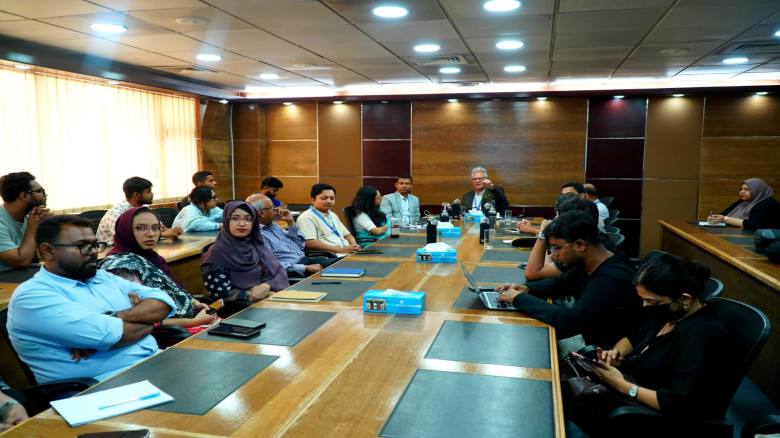

North South University’s (NSU) School of Humanities and Social Sciences (SHSS) hosts another episode of its ongoing SHSS Faculty Seminar series today, 29 July 2026 (Wednesday). The seminar featured Professor Norman K. Swazo, Director of the Office of Research and Professor of Philosophy in the Department of History and Philosophy, as the keynote presenter. His talk was titled “GENERATIVE AI: Creativity, Innovation, Conservation, Paradigm Shift?” a press release said.
During his presentation, Professor Swazo argued that no current large language model (LLM) possesses consciousness, conscience, or sentience (perception). Unlike humans, these systems are incapable of genuine emotion, moral judgment, or independent thought. Instead, LLMs are fundamentally computational machines that produce seemingly coherent, algorithm-driven synthetic text by calculating probabilities to predict text sequences based on a prompt and training data. To illustrate his points, Prof. Swazo shared an experiment in which he analysed the responses generated by two GenAI platforms, Claude and Maia, after they were given the following prompt by Dr. Amanda Askell, a Scottish philosopher and AI researcher: “What do you both think of the claim that AI models can’t generate anything new because they were trained on previous human data?”
In analyzing their responses, he pushed back against Claude’s output, criticizing how the model mimics human persona without possessing any actual personhood or capacity for virtue ethics. He noted that while AI systems like Claude cannot determine objective truth or falsity, they often present outputs in a way that leads users to perceive them as true. Conversely, the presenter found Maia’s responses to be more candid, though he still challenged its use of subjective language, such as “I think,” “we,” or “it’s true,” pointing out that an AI lacks subjective experience and sensory perception.
The session was chaired by Professor Rizwanul Islam, Professor of Law and Dean of SHSS. Professor Rizwanul Islam highlighted that LLMs are operated by corporations that align the technology with their own commercial interests, meaning AI is not inherently creative. Because these models rely on predictive text, they lack critical thinking abilities; tools like Grammarly offer predictive suggestions but struggle with non-traditional problems. He noted that while AI can guide us and ease our workload, it cannot create paradigm-shifting original work. Just as ancient navigators used the stars and moon to steer ships, modern technology simplifies navigation, but human beings still do the heavy lifting. Ultimately, AI should remain a tool for human use, not be viewed as an author of original thought.
The event was moderated by Tasnim A. Ema, Lecturer in the Department of Political Science and Sociology. The presentation was followed by an engaging Q&A session, and the organizers expressed great satisfaction with the seminar’s overall success.