
The government has set a target to generate 3,000 to 4,000 megawatts (MW) of electricity from solar sources by next summer, aiming to keep potential power shortages within a manageable range. To achieve this, the Power Division considers the installation of solar panels on building rooftops—or “rooftop solar” systems—to be one of the simplest and most effective solutions, a press release said.
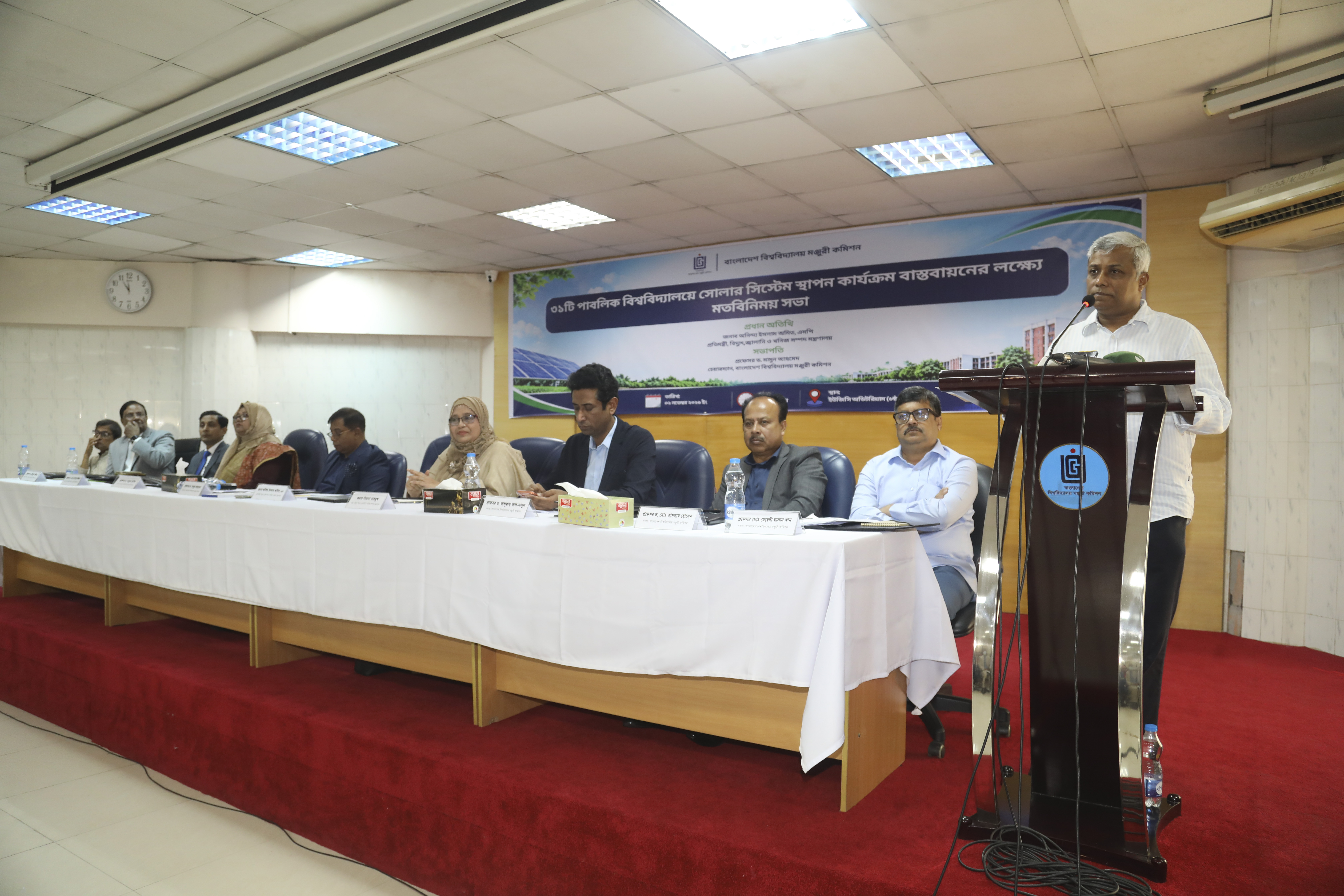
State Minister for Power, Energy and Mineral Resources, Anindya Islam Amit, shared these details on Monday (November 2) during a discussion meeting held in Agargaon, Dhaka. The meeting, organized by the University Grants Commission (UGC), focused on the installation of solar power systems across 31 public universities.
The State Minister stated that the government is working to ensure that the hardships faced by the public due to power shortages this past summer are not repeated next summer. A policy to expand the use of solar power was formulated in just two months. This policy, developed based on input from relevant stakeholders, remains open to future revisions as needed.
Emphasizing that the decision to install solar power systems in universities will not be imposed, he noted that any such move must take into account the specific needs, capacities, and realities of each individual university. The government and the UGC will provide the necessary support to implement this initiative.
The State Minister also highlighted the potential for universities to earn “carbon credits” by reducing carbon emissions through the use of solar power. He explained that the Power Division would assist universities in securing these credits. One carbon credit can be earned for every ton of carbon dioxide—or an equivalent amount of greenhouse gases—prevented from being emitted. Once the required verification and accreditation processes are completed, these credits can also be sold.
To further promote the adoption of solar energy in the country, the State Minister announced that a “Bangladesh Solar Expo” will be held in Dhaka on November 3 and 4. He added that a specialized meeting, involving university Vice-Chancellors, will also be organized to discuss the installation of solar power systems on campuses, and he invited the Vice-Chancellors of all universities to participate.
In his remarks while chairing the meeting, UGC Chairman Professor Dr. Mamun Ahmed stated that this meeting was organized to clear up existing confusion regarding the installation of solar power systems in universities and to gather input from relevant stakeholders. The University Grants Commission (UGC) has already conducted a survey on this matter. Furthermore, a committee has been formed to assess the feasibility of implementing this initiative; the committee will examine the potential for installing solar power systems on buildings at various universities, including the UGC’s own premises.
He emphasized that while universities will be provided with the necessary technical support, no decisions will be imposed upon them.
The UGC Chairman highlighted the importance of adopting the Operational Expenditure (OPEX) model for solar power installation, which aims to reduce the operational costs of universities. He noted that a significant portion of a university’s operating budget is spent on electricity and gas bills, and that increasing the use of solar energy could substantially lower these expenses.
Citing the initiative at Jashore University of Science and Technology (JUST) as an example, Professor Mamun Ahmed explained that the university has undertaken the installation and operation of a solar power system through a tripartite agreement. Similar initiatives could also be implemented at other universities.
He urged that the acquisition of carbon credits be incorporated into the planning from the outset, noting that there must be a mechanism to measure the reduction in carbon emissions resulting from the solar installations. The UGC will provide the necessary assistance in the process of obtaining carbon credits.
The UGC Chairman added that university vice-chancellors would be provided with the necessary guidance, draft agreements, and relevant information regarding solar power installation. If universities take the initiative now, work could begin within the next month.
During the meeting, Professor Dr. M. Shamsul Alam, a Dean at Daffodil International University, and Tahmilur Rahman, a Senior Assistant Secretary at the Power Division, presented papers on installing solar power systems on university rooftops and expanding them through the OPEX model.
Others who spoke at the event included Mirana Mahrukh, Secretary of the Power Division; Professor Dr. Masuma Habib, a member of the UGC; and the Vice-Chancellor of Jashore University of Science and Technology (JUST). Yarul Kabir; Professor Dr. S. M. Abdur Razzak, President of the Association of Universities of Bangladesh and Vice-Chancellor of the Bangladesh University of Engineering and Technology (BUET); Professor Dr. Md. Faridul Islam, Vice-Chancellor of Rajshahi University; Professor Dr. M. Enamullah, Vice-Chancellor of Hajee Mohammad Danesh Science and Technology University; and Dr. Md. Fakhrul Islam, Secretary of the University Grants Commission (UGC).
Additionally, UGC members Professor Dr. Abdullah-Al-Mamun, Professor Md. Mehedi Hasan Khan, and Professor Dr. Md. Aslam Hossain; Md. Omar Faruk, Director of the Commission’s ICT Division; as well as the Vice-Chancellors of 31 public universities and senior officials from the UGC were present at the meeting.