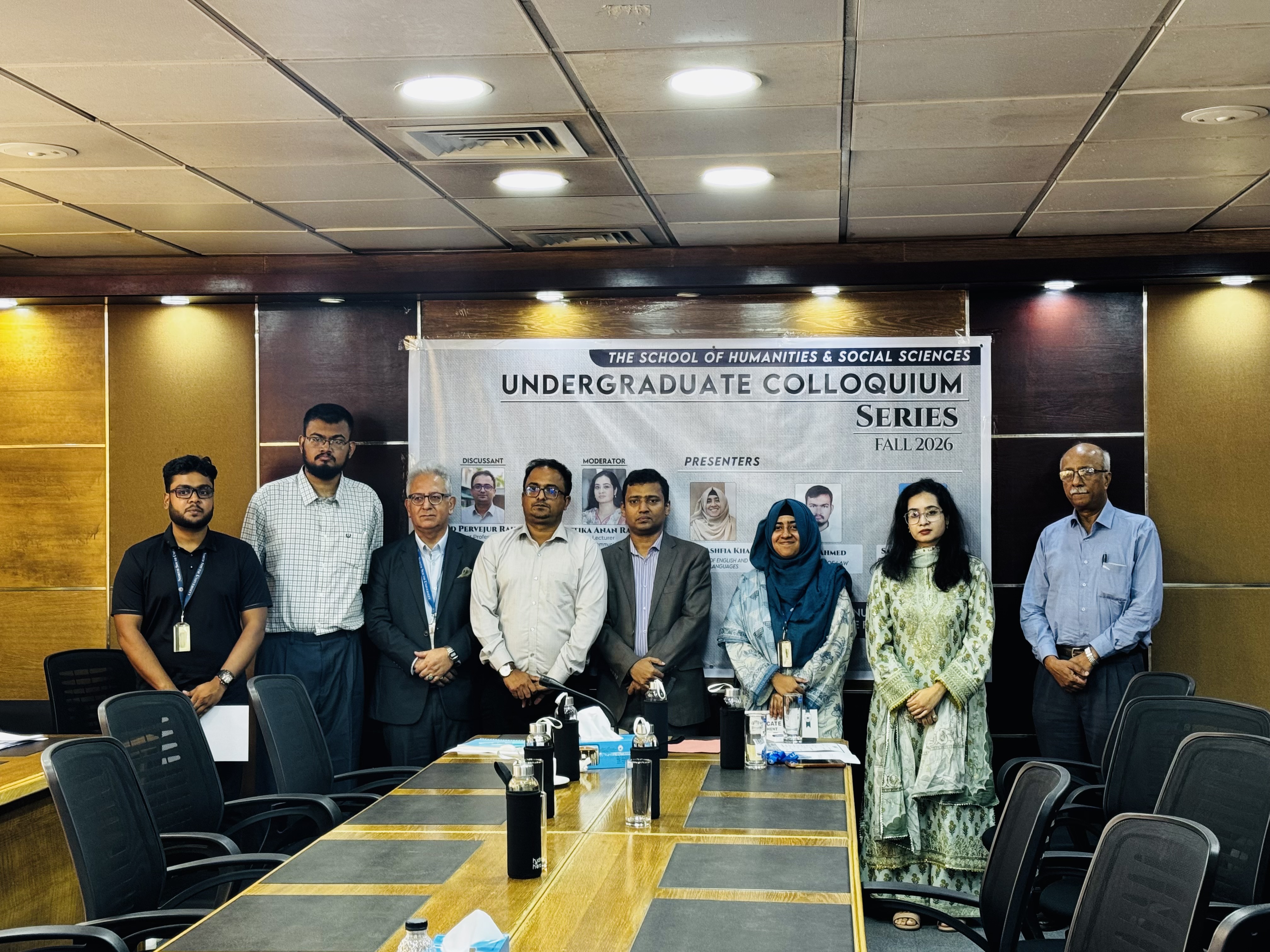

North South University School of Humanities and Social Sciences (SHSS) hosted another session of the Undergraduate Colloquium Series Fall 2026 on 28 October 2026 at the SHSS Conference Room (NAC 1024) in an engaging academic setting. The session featured research paper presentations by undergraduate students from different departments, a press release said.
The presenters included Noor-E-Ashfia Khan from the Department of English & Modern Languages, Robin Ahmed from the Department of Law, and Sarker Sanjid Advan from the Department of Media, Communication, and Journalism. Noor-E-Ashfia Khan presented a paper titled “Beyond the Myth of Critique: Uncovering the Colonial Bias in Heart of Darkness,” while Robin Ahmed presented “Between Rules and Threats: Rethinking Law in Developing Societies,” and Sarker Sanjid Advan presented the paper titled “The Political Economy of Private Media Ownership and State Restraints Over Political Transition in Bangladesh.”
The welcome speech was delivered by Professor Md. Rizwanul Islam, Dean of the School of Humanities and Social Sciences and Professor of Law. Dr. Md Pervejur Rahaman, Assistant Professor & Chair of the Department of History & Philosophy, served as the discussant, while the session was introduced by Mrittika Anan Rahman, Lecturer in the Department of Media, Communication and Journalism.
In his welcome speech, Professor Rizwanul Islam highlighted the growing research capabilities of North South University scholars, noting that NSU’s undergraduate students are performing exceptionally well not only in Bangladesh, but across South Asia. He remarked that several presentations in this colloquium series are truly world-class, showcasing vibrant dialogues, well-crafted issues, and the strong analytical skills and integrative ability of the student presenters. He also observed how liberal arts presentations and critiques offer a meaningful contrast to conventional STEM perspectives by providing diverse answers to complex questions.
Dr. Md Pervejur Rahaman, serving as the discussant, commended the quality of the research and offered targeted feedback to help the presenters refine their work. He encouraged stronger links between theory and core arguments, emphasized developing an independent scholarly voice, and suggested deeper analysis of structural factors and media perceptions.
Mrittika Anan Rahman moderated the session and delivered the introductory remarks. She expressed hope that seminars of this nature would occur more frequently and assist students in their future scholarly endeavors.
The presentations were followed by an interactive Q&A session, during which faculty members, students, and audience engaged with the presenters by offering reflections and posing thoughtful questions. The session concluded with appreciation for the presenters and their contributions, reflecting the School’s continued commitment to fostering a vibrant research culture.