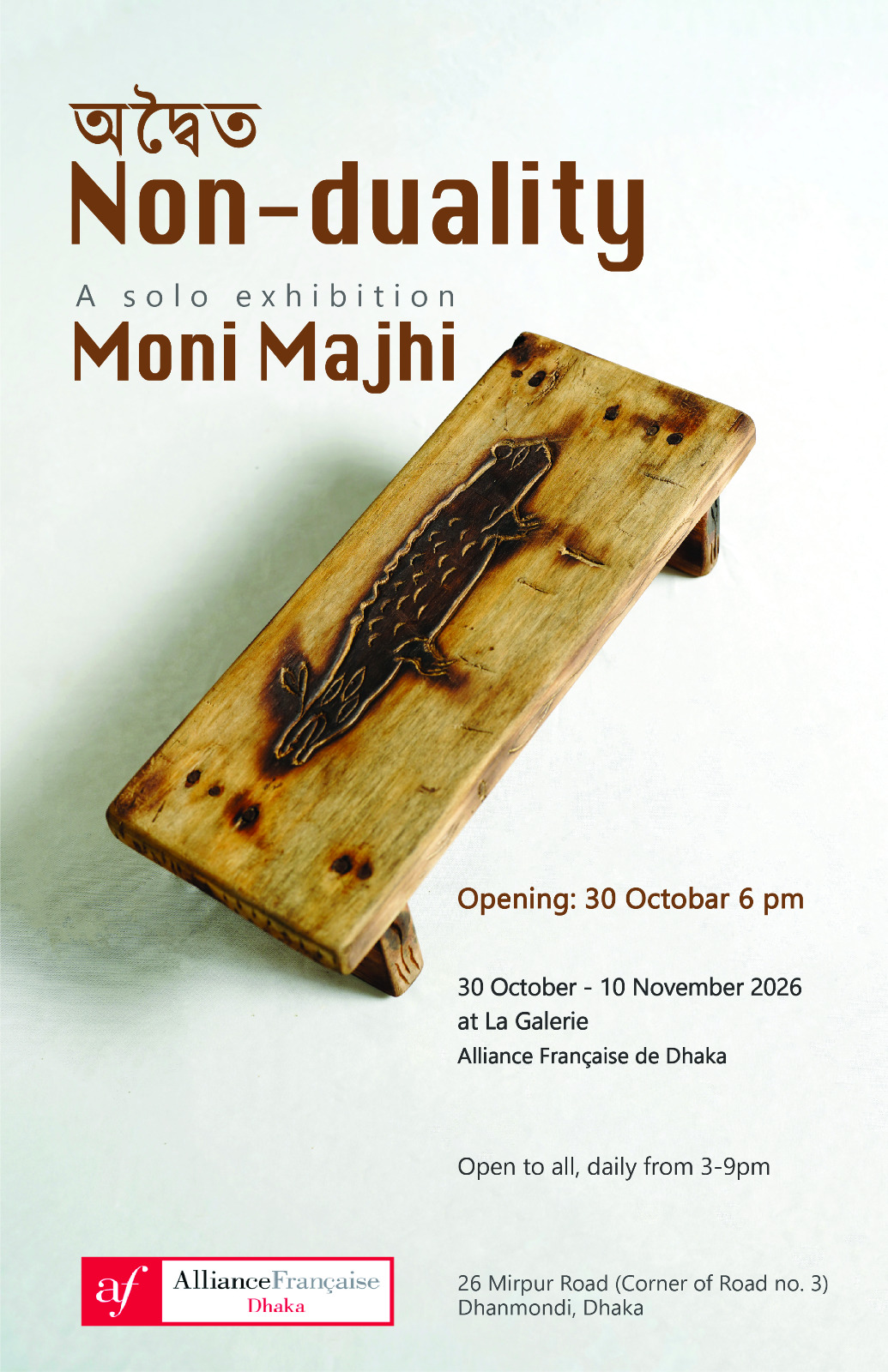

Alliance Française de Dhaka presents Non-duality (Adwaita), a solo exhibition by artist Moni Majhi exploring the deep interdependence between human life, the natural world, and the cultural traditions shaped by the riverine landscapes of the Sundarbans. The exhibition opens on 30 October 2026 at 6:00 PM at La Galerie, Alliance Française de Dhaka, and will remain open to the public until 10 November 2026, a press release said.
Rooted in the ecological and cultural landscape of the Sundarbans, Non-duality draws on the region’s rivers, forests, tides, saline waters, soil, animals, myths, and folk beliefs to reflect on a worldview grounded in coexistence, shared memory, and interconnectedness. Through the concept of Non-duality (Adwaita), the exhibition moves beyond the boundaries of religious doctrine to explore a lived cultural philosophy in which distinctions between beliefs, identities, and forms of life are fluid.
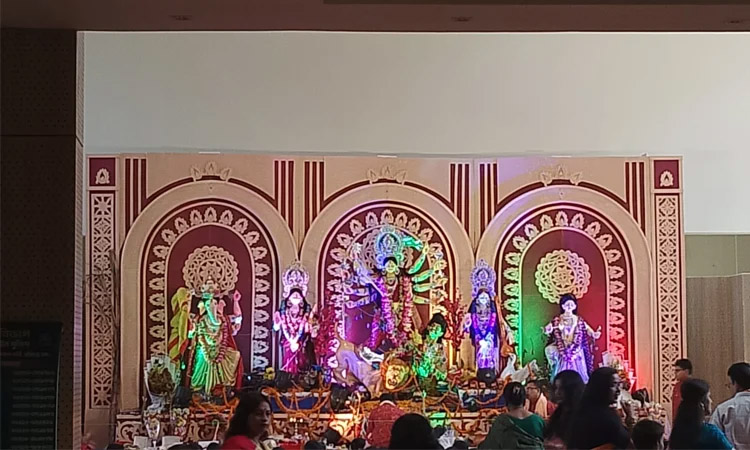
At the heart of the exhibition lies a cultural imagination that recognises shared identities across religious and spiritual traditions. Bon Durga and Bonbibi are understood as the same Mother, while Paban Thakur and Paban Pir belong to a shared realm of folk belief. These traditions reflect a way of life in which respect, hospitality, and coexistence are integral to everyday relationships between people, communities, and the natural world.
The exhibition also draws attention to the symbolic significance of everyday cultural practices. The piri, a low wooden stool traditionally offered to guests as a gesture of respect, becomes an expression of hospitality and belonging. Similarly, folk practices of offering sinni and payesh to natural forces. Such gestures embody reverence, vulnerability, and an acknowledgement of humanity’s dependence on a world it cannot fully control.Paban, the wind, during violent storms and heavy rain reveal an intimate relationship with
However, the relationships that sustain this interconnected existence are increasingly under threat. The struggle for power, the control of natural resources, development pressures, and the climate crisis are reshaping the ecological and cultural realities of the Sundarbans. Rivers change course, soil becomes increasingly saline, animal habitats disappear, and communities face the erosion of memory, language, and cultural identity.
Against this backdrop, Non-duality introduces the evocative idea that we have all become “refugees of the green.” Displacement, in this context, extends beyond human communities to encompass rivers, seeds, trees, animals, and other living beings whose habitats and ways of life are being altered or destroyed. The phrase invites audiences to consider ecological loss not as a distant environmental concern, but as a shared condition that affects the very foundations of existence.
Through Non-duality (Adwaita), Majhi revisits these threatened connections, inviting audiences to reflect on what is lost when relationships between people, culture, and nature are disrupted—and what might be recovered through renewed attention to them. Rather than positioning humanity as separate from or superior to the natural world, the exhibition proposes a more reciprocal understanding of existence, in which every life is part of a larger whole.
Ultimately, Non-duality (Adwaita), offers a meditation on belonging, displacement, and the possibility of reconnection. By bringing the cultural wisdom of the Sundarbans into dialogue with contemporary ecological concerns, the exhibition asks us to reconsider our place within the living world and recognise that our futures are bound together. We share the same earth, water, and breath; the survival of one is inseparable from the survival of all.