
DHAKA : The 2nd
International Conference on China-South Asia Civilisation and
Connectivity, co-hosted by Yunnan University and North South University
(Bangladesh), officially commenced at the Donglu Campus of Yunnan University.
This year’s theme, “Harmony in Diversity, Unity for All”, brought together over
60 experts and scholars from China, Bangladesh, India, Sri Lanka, Nepal,
Pakistan, and other nations. Participants gathered in Kunming, the “Spring City”,
to discuss civilizational dialogue, regional connectivity, economic and
cultural cooperation, and the “Global South.”
The conference was organised by the Center for China-South
Asia Social and Cultural Studies (CSSCS), a joint initiative of the School of
Ethnology and Sociology at Yunnan University and North South University and
hosted by the Center for Southwest Frontier Ethnic Minority Studies at Yunnan
University (under the Ministry of Education). The inaugural conference was held
in December 2024 at North South University in Bangladesh; it yielded
significant academic outcomes and established a regular channel for dialogue
among scholars from the two universities and the participating countries.
Building upon the foundations laid by the first event, this edition, held in
Kunming, seeks to further deepen cooperation between academic communities in
China and South Asian nations in the realms of mutual civilizational learning
and cultural exchange.
Ma Wenhui, President of Yunnan University, stated at the
opening ceremony that China and South Asia are linked by both geography and
cultural heritage, with a history of civilizational exchange spanning more than
two millennia. Yunnan University has cultivated deep expertise in South Asian
studies. The university remains committed to utilising its regional and
disciplinary strengths to provide intellectual support for people-to-people and
cultural exchanges between China and South Asia. This conference will foster
mutual understanding between the peoples of China and South Asian nations.
In his address, Professor Abdul Hannan Chowdhury,
Vice-Chancellor of North South University (NSU) in Bangladesh, reflected on the
two-decade-long partnership between Yunnan University and NSU that began with
the establishment of the Confucius Institute at NSU in 2006 and continued with
the founding of the China-South Asia Center for Socio-Cultural Studies in 2023,
and has evolved from language and cultural exchange into interdisciplinary
academic research and joint talent cultivation.
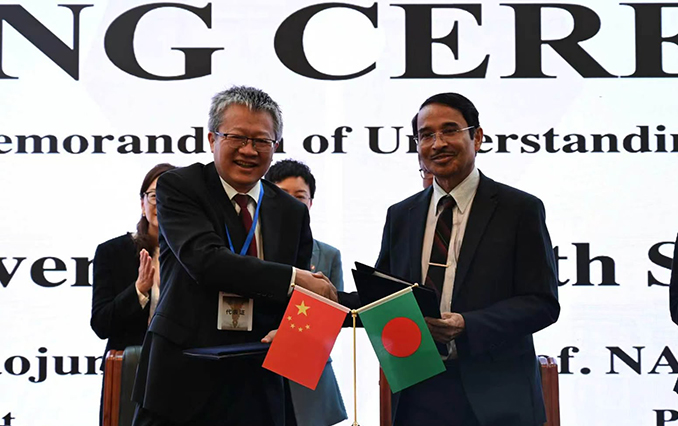
During the opening ceremony, Professor Nasar U. Ahmed, Pro
VC of North South University and Professor Yang Shaojun, Vice President of
Yunnan University, signed a memorandum of understanding on inter-university
cooperation and launched a joint “2+1+1” undergraduate program in anthropology.
This marks a new phase in their partnership and talent cultivation, and
establishes a solid foundation for the continued deepening of exchanges and
cooperation between the two universities.
Following the opening ceremony, a keynote session featured
presentations from several Chinese and international scholars on their latest
research. Professor Jing Jun from Tsinghua University explored the issue of
artificial intelligence sovereignty from the perspective of the “Global South.”
Professor Sk. Tawfiq M. Haque, Director, South Asian Institute of Policy and
Governance (SIPG), NSU, Bangladesh, analysed the opportunities and structural
contradictions in 21st-century China-South Asia relations through
economic, strategic, and human-centered lenses. Professor Mohammad Bulbul
Ashraf Siddiqi, Director, Confucius Institute, NSU, focused on the
Bangladesh-China-Myanmar Economic Corridor, arguing that Bangladesh’s
participation in the corridor must balance economic gains, strategic autonomy,
and human security. Professor He Ming from Yunnan University drew upon the
philosophy of Fei Xiaotong encapsulated in the sixteen-character principle: “Appreciate
the beauty of one’s own culture, recognise the beauty in others’ cultures,
share the beauty of all cultures, and achieve a world of harmony and unity” to
elucidate the theoretical foundations, contemporary significance, and prospects
of mutual learning between Chinese and South Asian civilisations.
Over the next two days, the participating scholars will
engage in seven parallel breakout sessions. These sessions will focus on key
themes including China’s political and diplomatic relations with South Asia,
infrastructure connectivity, media communication, inter-civilizational exchange
and mutual learning, economic and technical cooperation and regional
development, public health, and knowledge production and development
cooperation within the “Global South” through the presentation of research
papers and collective discussion.