
DHAKA : North South University Law & Mooting Society
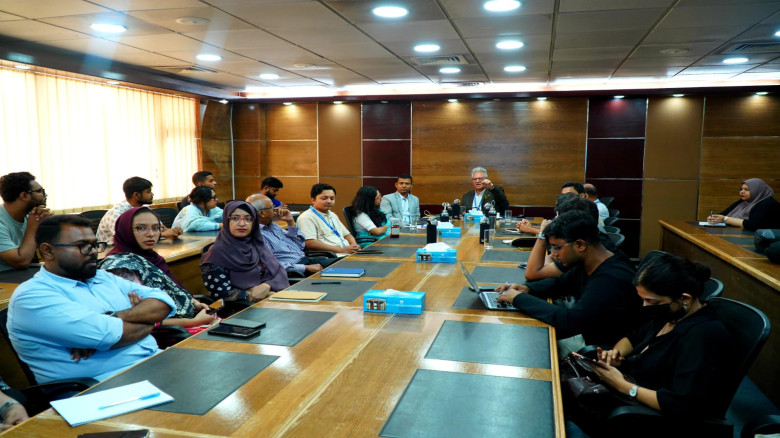
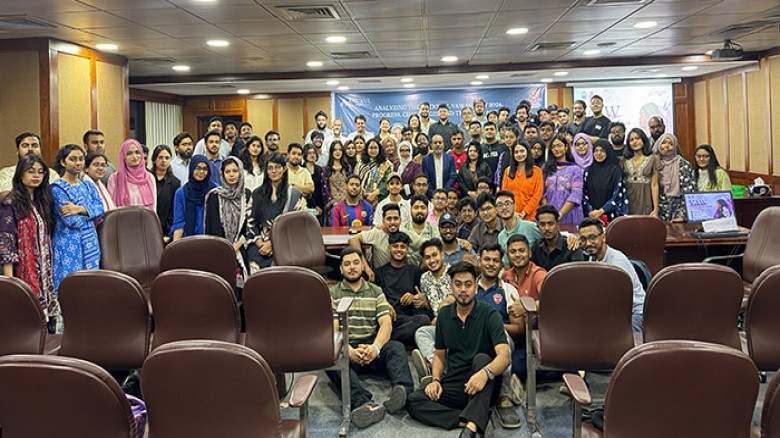
(NSULMS), in collaboration with ANUKUL, organized a seminar titled “Analyzing
the National VAW Survey 2024: Progress, Challenges, and the Road Ahead” on 14
October 2026 at North South University. The seminar brought together
distinguished professionals from the fields of gender development, the judiciary,
and legal practice to examine the findings of the National Violence Against
Women (VAW) Survey 2024 and discuss the challenges women face in accessing
justice, as well as the institutional and policy measures needed to address
them.
The seminar featured three distinguished panel speakers:
Shamima Pervin, Chief of Gender at UNFPA Bangladesh; Mohammad Faruque, District
and Sessions Judge, Women and Children Repression Prevention Tribunal,
Manikganj; and Ishrat Hasan, Advocate, Appellate Division, Supreme Court of
Bangladesh.
In her presentation, Shamima Pervin highlighted the key
findings of the National VAW Survey 2024, which examined different forms of
violence against women, including physical, sexual, emotional, economic, and
technology-facilitated violence. The survey, which interviewed 27,476 women
aged 15 and above, revealed that seven in ten ever-married women had
experienced violence by a husband during their lifetime. She also highlighted
the persistence of violence within intimate relationships, the prevalence of
technology-facilitated gender-based violence, and the limited number of
survivors who seek formal legal action. According to the survey, only 7.4% of
survivors of intimate partner violence and 3.8% of survivors of non-partner
violence took legal action.
Shamima Pervin further addressed the social stigma and
institutional barriers that discourage survivors from seeking justice. She
emphasized that victims and their families may face threats from perpetrators,
while victim-blaming attitudes can make reporting violence even more difficult.
Referring to a recent rape case, she stressed that a woman’s personal choices
or circumstances can never justify sexual violence. She also highlighted the
psychological burden survivors face when repeatedly required to recount
traumatic experiences, the prolonged process of obtaining compensation, and the
lack of adequate legal recognition of certain forms of violence within intimate
relationships. Her discussion underscored the need for survivor-centred institutional
responses, stronger legal protection, and accessible support services.
Drawing from his experience in the judiciary, Mohammad
Faruque discussed the practical challenges that prevent women from obtaining
justice. He highlighted how social pressure, financial insecurity, and fear of
social and political consequences often compel victims to compromise with
perpetrators or withdraw from legal proceedings. Many women are unable to
continue their cases or appear as witnesses because they lack the financial
resources and social support required to sustain lengthy legal processes. He
also raised concerns about the uncertainty survivors face when perpetrators do
not receive appropriate punishment, emphasizing that access to justice requires
not only legal procedures but also an environment in which victims can pursue
their cases without fear or coercion.
Ishrat Hasan, Advocate at the Appellate Division of the
Supreme Court of Bangladesh, focused on the relationship between gender-based
violence, economic vulnerability, and access to justice. She highlighted the
difficulties women may face after divorce, including pursuing dower claims,
supporting their children, and maintaining their livelihoods. She observed that
although many laws prescribe punishment for perpetrators, comparatively less
attention is given to the survivor’s long-term financial security and ability
to rebuild her life. She also discussed the challenges women encounter when
police refuse to register complaints, noting that they may have to approach the
court directly to seek legal remedies. Furthermore, she raised concerns about
the burden of proof placed on victims and the pressure on the justice system,
referring to the significant caseload faced by judges. She called for
collective efforts from legal professionals, institutions, and society to
ensure that women can access justice effectively and receive meaningful support
beyond the punishment of offenders.
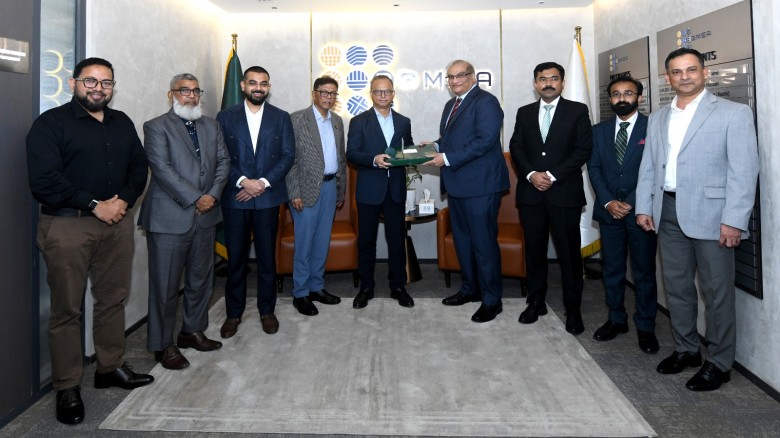
Following the discussion, tokens of appreciation were
presented to the panel speakers by representatives of ANUKUL and Nasmin Jabin
Noor, Senior Lecturer, Department of Law, North South University, and Faculty
Advisor of NSULMS. A representative of ANUKUL also presented a token of
appreciation to Nasmin Jabin Noor in recognition of her role in arranging the
seminar.
The seminar provided an important platform for examining
the findings of the National VAW Survey 2024 beyond statistics, bringing
attention to the lived experiences of survivors and the institutional
challenges that continue to hinder their access to justice. The discussions
emphasized the importance of translating research findings into effective
policies, strengthening institutional accountability, ensuring survivor-centred
legal procedures, and expanding access to financial, social, and psychological
support for women affected by violence.
North South University Law & Mooting Society (NSULMS)
remains committed to organizing more initiatives of this nature to promote
legal awareness, encourage informed dialogue on pressing social and legal
issues, and contribute to meaningful institutional and societal change. Through
collaborative seminars and knowledge-sharing initiatives, NSULMS seeks to strengthen
the connection between legal education and real-world challenges while
fostering a more equitable, accountable, and just society.