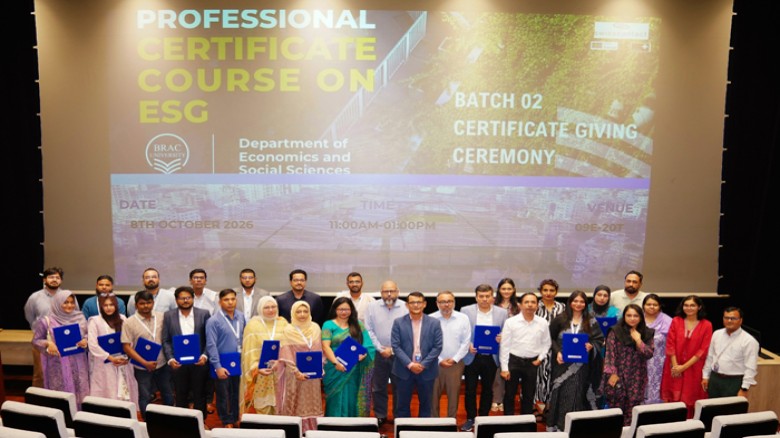

BRAC University’s Department of
Economics and Social Sciences organized a ceremony on the Merul Badda campus in
Dhaka on Thursday to award certificates to the second cohort of 24 participants
who completed a 60-hour professional ESG certificate course.
ESG (environmental, social, and
governance) is a framework used to evaluate an organization’s activities
regarding environmental impact, social responsibility and governance.
When it comes to Bangladesh’s
industrial growth, ESG is fast becoming central to market access, export
competitiveness, investment readiness and long-term resilience.
The course was developed by
BRAC University under Swisscontact’s PROGRESS initiative, with support from the
embassies of Sweden and Switzerland in Bangladesh, and facilitated by both
academic experts and industry practitioners.
It offers professionals from
various sectors the opportunity to gain practical knowledge in sustainable
business practices, investment, reporting and responsible decision-making.
“Adhering to ESG and
sustainable development standards has become crucial for Bangladesh’s
export-oriented industrial sector,” said Professor Muhammad Wasiqur Rahman
Khan, chairperson of the Department of Economics and Social Sciences.
“It is not just the industrial
sector; banks, financial institutions, and various business enterprises are
also increasingly prioritizing ESG factors when making strategic decisions,” he
said in the welcome address.
He further mentioned that BRAC
University was working to develop a skilled workforce in the field of ESG.
BRAC University is currently
working to get regulatory approval for a postgraduate diploma in ESG and has
plans to introduce a full-fledged master’s program in the future, he added.
Farzana Amin, team leader of
the PROGRESS project, noted that transitioning to a green and sustainable
industrial system in Bangladesh cannot happen overnight; it is a long-term
journey.
She said, “The green transition
we speak of takes time. It requires collaborative effort among the government,
the industrial sector, educational institutions, and development partners. This
transformation is not possible without collective action.”
Shirin Sultana, senior program
manager (Governance, Climate Change, and Environment) at the Embassy of
Switzerland, said, “We cannot always rely on international assistance; we must
build our own capacity.”
“Universities and educational
institutions need to play a more significant role in this regard,” she said.
“We must consider future
generations. The world has changed, and business-as-usual is no longer an
option. Now is the time to reflect on how we can become a more sustainable and
self-reliant nation,” she added.
Addressing the participants,
BRAC University Treasurer Ariful Islam stated that ESG was not merely about
regulatory compliance as it helps make an organization stronger and more
sustainable in the long run.
“Sound decision-making,
capacity building, risk management, and the efficient use of resources—all of
these are integral parts of ESG,” he said.
“Those of you who have
completed this course should apply this knowledge in your workplaces. This will
not only benefit the organization but also help create a better world for
future generations,” he added.
During the event, participants
shared their experiences and views. They noted that the course provided them
with new perspectives on their professional lives and offered an opportunity to
gain practical knowledge regarding ESG.
Dr Shahidur Rahman, coordinator
of the ESG Program at BRAC University, delivered the concluding remarks.