
An agreement has been signed between the Higher Education Acceleration and Transformation (HIT) project and the Bangladesh Research and Education Network (BdREN) to enhance access to international e-resources for teachers, researchers, and students at the country’s public and private universities, a press release said.
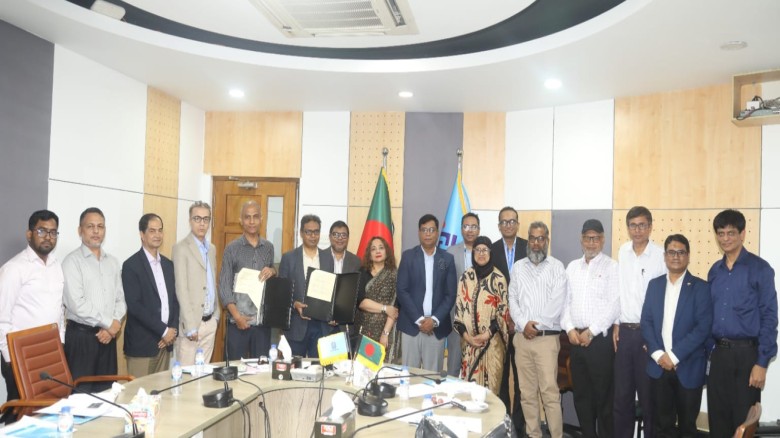
The agreement regarding “E-books for UGC Digital Library” was signed on Thursday (September 24) at the University Grants Commission (UGC) conference room.
Mohammad Tawrit, CEO of BdREN, and Professor Dr. Asaduzzaman, Director of the HIT project, signed the agreement in the presence of UGC Chairman Professor Dr. Mamun Ahmed.
Officials from the UGC, Bangladesh Accreditation Council, BdREN, the HIT project, and the World Bank—including World Bank Practice Manager Dr. Sherezad Joya and Senior Education Specialist and HIT Project Task Team Leader T.M. Asaduzzaman—were present at the event.
Under this agreement, teachers, researchers, and students from 76 public and private universities across the country will gain access to over 30,000 e-books, e-journals, and various research materials from seven international organizations.
Emphasizing the importance of increasing the use of e-resources, the UGC Chairman stated that these resources are being procured based on the needs of the universities and the country’s priority sectors. This will enable teachers and researchers to easily access international e-books, e-journals, and other research materials.
He said, “We must increase the use of e-resources in universities to enhance the quality of education and research. We need to leverage this facility to advance the country’s research sector. The UGC is working on ways to further expand the use of e-resources in research.”
Highlighting initiatives for the digital transformation of universities, Professor Dr. Mamun Ahmed mentioned plans to expand high-speed Wi-Fi and broadband internet services and establish systems for sharing e-resources. These measures will strengthen digital connectivity among domestic universities as well as with universities abroad. Initiatives are also being taken to connect academics and researchers based abroad with the country’s universities through digital platforms.
The UGC Chairman stated, “The UGC is taking effective measures to transform the country’s universities into fully functional digital campuses.”
The project’s progress was reviewed at a separate meeting held in conjunction with the mid-term review mission of the HiT project. During the meeting, the UGC Chairman highlighted the need to extend the project’s duration.
He noted that the implementation of the HiT project lacked the desired momentum during the post-COVID-19 pandemic period and the tenure of the interim government. Currently, work is proceeding in full swing to achieve the project’s objectives.
“We must ensure significant progress within the stipulated timeframe. For nearly two years after its inception, implementation did not proceed at the desired pace. Therefore, extending the project’s duration for a specific period could be considered if necessary to achieve the intended goals,” he said.
At the meeting, HiT Project Director Professor Dr. Asaduzzaman and other project officials outlined the progress made and highlighted various challenges associated with implementation.