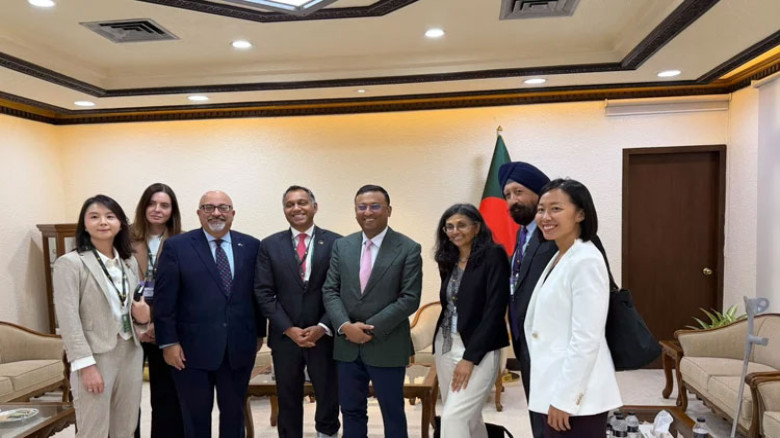
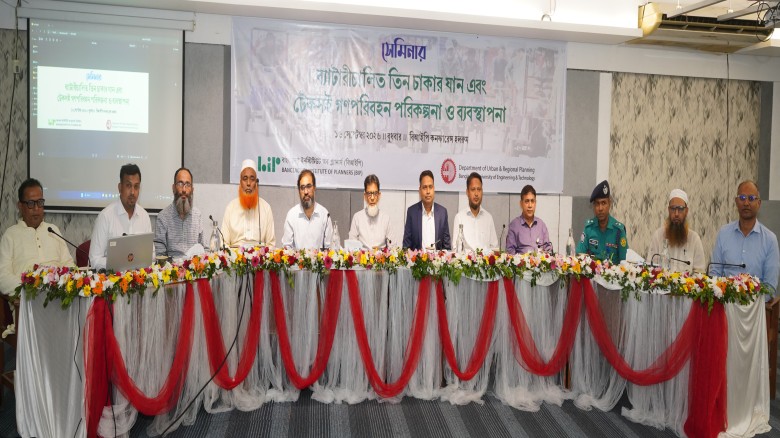

A seminar titled ‘Battery-Operated Three-Wheeler Vehicles and Sustainable Public Transport Planning and Management’ was held on September 16, 2026 (Wednesday) at 2:15 PM. The event took place at the BIP Conference Hall in Planners Tower, Banglamotor, Dhaka, and was jointly organized by the Bangladesh Institute of Planners (BIP) and the Department of Urban and Regional Planning at the Bangladesh University of Engineering and Technology (BUET). Habibur Rashid, Honorable State Minister for Road Transport and Bridges, attended as the chief guest. The seminar was moderated by BIP Joint Secretary and Planner Kazi Salman Hossain and presided over by BIP President and Planner Dr. Muhammad Ariful Islam. Special guests included Md. Anisur Rahman, Additional Secretary (Urban Transport Wing) of the Road Transport and Highways Division; Planner Mir Ahmed Tarikul Omar, Additional Secretary (Development) of the Ministry of Shipping; Dr. Md. Mashiur Rahman, Additional Executive Director (Additional Secretary) of the Dhaka Transport Coordination Authority; Md. Rafiqul Islam, Deputy Commissioner of Police (Dhaka-Tejgaon) of the Dhaka Metropolitan Police; and Planner Professor Dr. Adil Muhammad Khan, Convener of the BIP Advisory Council. Other notable attendees included BIP Advisory Council Member Planner Dr. Akhtar Mahmud; Professor Dr. S. M. Sohel Mahmud, a researcher at the Accident Research Institute (ARI); transport expert and Planner Syed Waliullah; BIP Vice-President Planner Sheikh Muhammad Mehedi Ahsan; and General Secretary Planner Professor Dr. Mu. The event was attended by Board Members (including Planner Mosleh Uddin Hasan for Academic Affairs, Planner Shuvo Kanti Poddar for National and International Liaison, Planner Talha Tasnim for Membership Affairs, and Planner Sadi Mohammad Harun) and Planner Tahsin Reza, alongside relevant government officials, planners, academics, researchers, journalists, and professionals, a press release said.
In his welcome address, BIP Joint Secretary Planner Kazi Salman Hossain outlined the seminar’s context, emphasizing the rising use of battery-operated three-wheelers in urban life, their impact, and the need to understand the perspectives of various stakeholders regarding this issue. Subsequently, a presentation was delivered covering BIP’s history, vision, strategic planning, and the role of planners at both national and local levels.
The keynote paper was presented by BIP General Secretary Planner Professor Dr. Md. Mosleh Uddin Hasan and Planner Tahsin Reza. At the outset of the presentation, Planner Professor Dr. Md. Mosleh Uddin Hasan highlighted various modes of urban transport and the fundamentals of transport planning. He emphasized the importance of categorizing and managing battery-operated three-wheelers (BTW) as distinct motorized vehicles—based on their speed, movement patterns, and road usage—rather than equating them with conventional rickshaws. The study also examined the socio-economic status, income, previous occupations, and alternative livelihood prospects of the drivers, as well as the reasons why passengers—particularly women—prefer these vehicles. The research revealed significant differences in speed and headway between battery-operated three-wheelers and conventional rickshaws. Specifically, the study found a headway of approximately 1.3 seconds for BTWs, which is lower than the conventional 2 seconds and could pose road safety risks during sudden incidents. At the same time, these vehicles offer a means of rapid and relatively comfortable travel over short distances. The presentation also highlighted shifts in the modal share of transport compared to the URSTP 2023 and RSTP 2014 plans, noting a decline in the share of public transport alongside an increase in the use of rickshaws and motorized three-wheelers. Concluding his remarks, he stated that there is no alternative to a robust public transport system for resolving the city’s long-term transport issues. However, this does not imply the abrupt elimination of rickshaws or battery-operated three-wheelers; rather, these vehicles need to be brought under proper regulation and management. He remarked that the existence of an effective BRT system in Dhaka would have significantly strengthened the public transport network. He emphasized an integrated transport plan centered on walking, cycling, and public transport. The presentation also underscored public transport, walking, and cycling as key components of a long-term solution for urban transport.
Participating in the discussion on the keynote paper, Professor Dr. S. M. Sohel Mahmud, a researcher at the Accident Research Institute (ARI) of BUET, stated that a clear policy and narrative regarding battery-operated three-wheelers must be established at the outset. He noted the need for more reliable domestic research to determine the true extent of the negative impacts caused by these vehicles. He pointed out that the local transport system has become heavily dependent on these vehicles, given the vast number of people involved in the sector—including owners, drivers, mechanics, and their families. Citing the example of Chattogram, he argued that it is possible to regulate these vehicles through appropriate policies and management. He also emphasized the importance of regulating the import of spare parts, manufacturing facilities, and charging stations, while simultaneously ensuring the availability of alternative transport and affordable public transport options.
Transport expert and planner Syed Waliullah observed that battery-operated three-wheelers are currently widespread across almost the entire urban area of Dhaka.