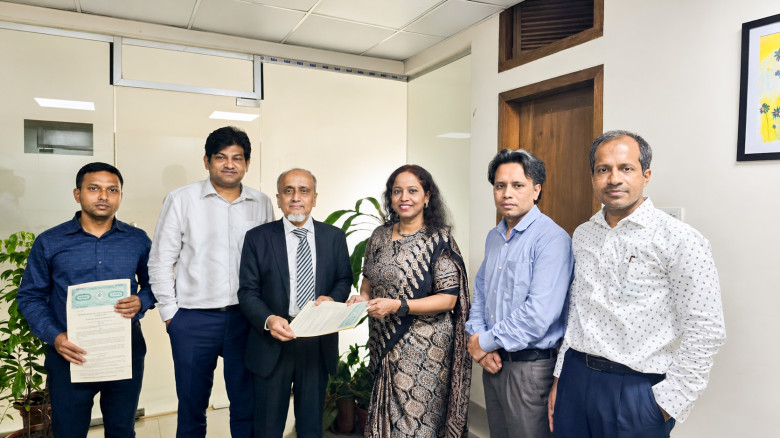


DHAKA : Daffodil International University (DIU) formally
inaugurated the Centre for Governance Studies (CGS) and organized a national
roundtable conference titled “Governance and Institutions: Connecting
Knowledge, Policy and Practice for Better Governance in Bangladesh” at its
International Conference Hall in Birulia, Dhaka.
The inauguration ceremony was graced by the Finance and
Planning Adviser to the Prime Minister Dr. Rashed Al Mahamud Titumir as the
Chief Guest. Professor Dr. Mahbub Ullah, National Professor of Bangladesh,
attended the programme as the Guest of Honour. The event was presided over by
Dr. Md. Sabur Khan, Chairman, Board of Trustees, Daffodil International
University.
The event brought together eminent academics,
policymakers, governance experts, researchers, development practitioners,
senior civil servants, representatives of the private sector, and media
professionals to discuss the challenges and opportunities of strengthening
governance and institutions in Bangladesh.
In his address, the Chief Guest emphasized the importance
of effective institutions, evidence-based policymaking, accountability,
transparency, and innovation-driven governance in making Bangladesh’s development
vision more inclusive and sustainable. He stated that stronger partnerships
among the government, academia, the private sector, and civil society are
essential to address emerging challenges and ensure sustainable development. He
further observed that there is no alternative to strong institutions and
effective governance for Bangladesh’s successful LDC graduation, sustainable
economic transformation, and its aspiration to become a developed nation.
Speaking as the Guest of Honour, Professor Dr. Mahbub
Ullah stressed the need for strengthening institutions and promoting
knowledge-based policymaking. He underscored the critical role of universities,
think tanks, and research institutions in generating evidence and policy
insights to support national development and good governance.
In his presidential remarks, Dr. Md. Sabur Khan reaffirmed
DIU’s commitment to quality education, research, innovation, and social
transformation. He noted that the establishment of the Centre for Governance
Studies reflects the university’s vision of creating a platform where
knowledge, policy, and practice can converge to address national development
challenges and contribute to institutional excellence.
The Vice Chancellor of Daffodil International University
stated that universities must serve not only as centers of learning but also as
catalysts for policy innovation and social progress. He expressed confidence
that CGS would emerge as a leading center for governance research, policy
dialogue, executive education, and capacity development in Bangladesh.
The roundtable conference featured insightful discussions
by distinguished scholars, governance specialists, development partners, and
practitioners on public sector reforms, institutional effectiveness, regulatory
governance, digital transformation, accountability mechanisms, citizen-centric
service delivery, and evidence-based policymaking. Participants emphasized the
need to strengthen public institutions, enhance transparency and
accountability, improve regulatory quality, invest in research and innovation,
and promote greater collaboration between academia and policymakers.
The newly established Centre for Governance Studies (CGS)
aims to serve as a national platform for interdisciplinary research, policy
dialogue, executive education, leadership development, and knowledge exchange.
Through research, training, publications, policy advocacy, and stakeholder
engagement, the Centre seeks to contribute to better governance, stronger
institutions, and informed public policymaking in Bangladesh.
The programme concluded with a collective commitment from
participants to continue fostering collaboration among academia, policymakers,
practitioners, and development partners to promote good governance and
institutional development in the country.