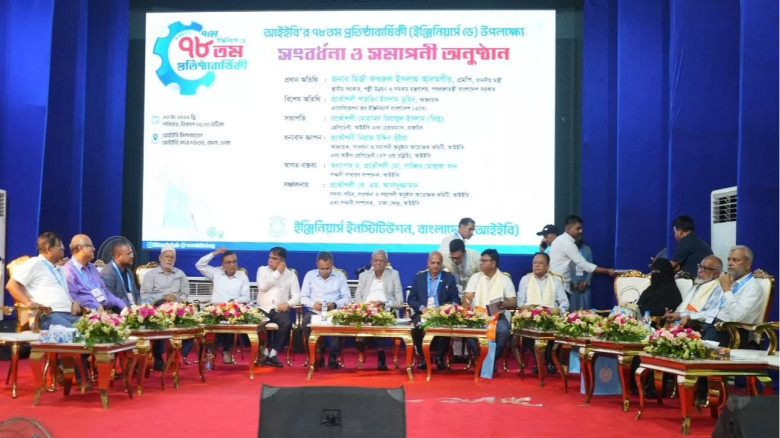


A roundtable discussion titled “Panthakunja Park: Fight for the ‘Urban Commons’ in Dhaka” was held at the BIP Conference Hall located at the Planners Tower in the capital today, 25 July 2026 (Saturday) at 10:30 am. As part of “The Five City Masterclass Series: Ordinary Ecologies of Repair” conducted under the Urban Studies Foundation (USF) Award 2025, the Interdisciplinary Center for the Study of Global Change, Department of Urban and Regional Planning, BUET, Bangladesh Tree Protection Movement, Bangladesh Institute of Planners (BIP), and Duniyadari Archive jointly organized this roundtable discussion, a press release said.
General Secretary of Bangladesh Institute of Planners (BIP), Planning Professor M. Moderated by Mosleh Uddin Hasan, the coordinators of Bangladesh Tree Protection Movement, Amirul Rajib and Naeem Ul Hasan, presented keynote papers. They highlighted the potential impact of the implementation of the elevated expressway project in the Panthakunja Park area on the city’s open spaces, environment and civic life.
In his keynote paper, Amirul Rajib, the coordinator of Bangladesh Tree Protection Movement, gave a brief idea about the goals and activities of Bangladesh Tree Protection Movement at the beginning. He said that there are various questions about the role and involvement of RAJUK and REHAB in approving various large development projects in Dhaka. According to him, due to the priority given to the interests of the housing sector, civil rights and environmental issues are being neglected in many cases. He also mentioned that the influence of various parties is observed in the revision of DAP and a section of the media also fails to convey the real information to the people properly due to the influence of various vested interests. He claimed that the implementation of the Panthakunja project has resulted in the removal of about 2,000 trees, which has damaged biodiversity and wildlife habitats.
Bangladesh Tree Protection Movement Coordinator Mr. Naeem Ul Hasan presented various aspects of the Panthakunja movement. He presented photographs of the 168-day movement, the process of organizing citizens and filing a writ in court. He also highlighted various important issues including the limitations of the project feasibility study, non-compliance with the Dhaka city plan, questions related to project cost and loss of lives of ordinary people due to the project implementation.
After the main presentation, a question and answer session was held with students, journalists and the participants present. The issues of unplanned urbanization of Dhaka, open space crisis, pollution, lack of safe shelter during earthquakes and deterioration of the quality of life of the city dwellers came up with importance in the discussion.
Sadman Shakib, a resident of the Katalbagan area, said that the local residents were not adequately informed about the elevated expressway project. He mentioned that the Panthakunja area was one of the most important open spaces for the locals and the long-term social, environmental and public health impacts of the project need to be considered seriously.
Barrister Nishat Mahmud, a lawyer at the Supreme Court of Bangladesh, said that even though the court has taken a stand in favor of environmental protection, proper implementation of the law is not being ensured. He stressed the importance of effective implementation of laws related to the environment and public interest.
Mohaiminul Bashar Raj, a member of the Bangladesh Tree Protection Movement, said that multi-dimensional solutions, increasing public awareness, expanding education and active participation of the youth are essential to deal with the current crisis. Rafia Mahjabin Bushra, another member of the same organization, said that Dhaka is gradually losing its livability due to pollution. She emphasized the need for a citizen movement to protect the environment.
Syeda Ratna, coordinator of the Tentultala Field Protection Movement, said that non-violent citizen movements never fail. She highlighted the importance of open spaces in the healthy development of children and called on citizens to participate consciously.
Matin Abdullah, President of the Urban Development Journalists Forum, thanked the Bangladesh Institute of Planners (BIP) for organizing such an event. He called for further strengthening of investigative journalism on environment and urban development.
Syed Shahariar Amin, former vice-president of BIP, planner, said that open fields, reservoirs and parks are essential for a livable city. He emphasized on good governance, environmental conservation and changing social values.
Amina Ansari, member of Bangladesh Tree Protection Movement and Alai Kendra, highlighted the importance of parks and open green spaces to maintain the ecological balance of the city. On the other hand, Shah Newaz Saikat, member of Bangladesh Tree Protection Movement, said that it is possible to restore the environment and open spaces through public awareness and collective efforts.
Sanjana Maria Kabir, a resident of the Katalbagan area and a student of the University of Asia Pacific, highlighted the pollution, traffic congestion and its impact on public health in the city and called for finding long-term solutions.
Planner Niaz Rahman said that one of the reasons for such problems is institutional weakness and lack of accountability in the planning process. He stressed the need to more actively involve university teachers, researchers and experts in planning.
Writer and thinker Firoz Ahmed said that administrative decisions and management are more responsible for the destruction of parks and reservoirs than the people. Experts and ordinary people should ensure the participation of citizens in the planning process in this regard.